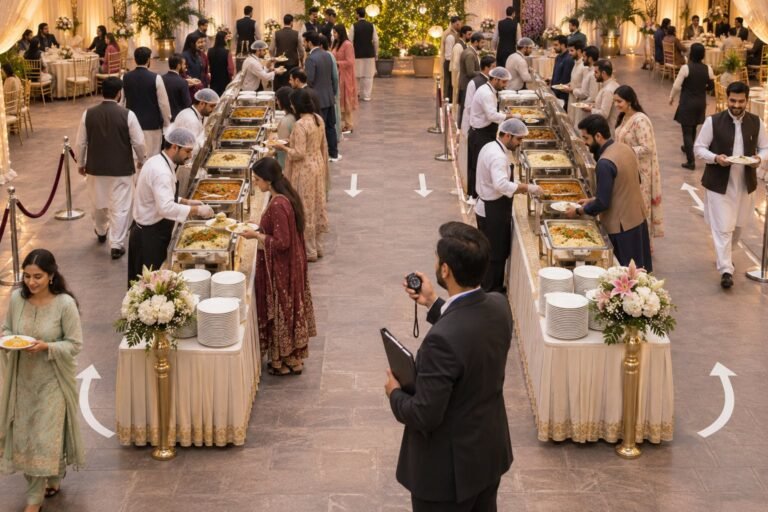
A buffet can have enough food and still form a long line. A short rehearsal shows whether the hold-up comes from the serving station, a shared entry point, or the way guests move. Use a test with real plates and serving choices before deciding how many lines to open.
Planning the numbers? Open the Buffet Portion Allocation Calculator before filling in the worksheet.
Separate Food Quantity From Line Speed
The portion calculator helps decide how much food belongs at each station. A timed rehearsal answers how many people can finish the station in a given period. A line with plenty of food can still stop when people wait for plates, make a choice, or cross other guest traffic.
Decide where the line starts and where it finishes. A useful boundary might be from the plate pickup point to the exit of the last food station. If drinks are served separately, time that line on its own when it has its own wait.
Run a Rehearsal With Real Service Steps
Set out the same serving utensils, dish labels, and staff positions planned for the event. Ask participants to make normal choices. Include typical interruptions such as a refill, a question about ingredients, or a guest asking for assistance.
Start from an active line or note the time it took to fill. Count completed guests during a fixed window of five or ten minutes. Repeat with a different group and record delays. One person walking a clear line at full speed does not reveal where a crowd will slow down.
A rehearsal should keep normal procedures in place. Use small fresh display pans where that suits the service plan, as described in the FDA Buffet Service Guidance guidance. Plan the staff path for replacements before you run the clock.
Compare Completion Rate With Peak Arrivals
Suppose one line completes 18 guests in five minutes. That is 3.6 guests per minute. If 72 guests are expected to reach the service area in 15 minutes, that averages 4.8 arrivals per minute. At the measured pace, one line would complete about 54 in that time.
Two equally staffed lines at 3.6 per minute could complete roughly 108 guests in 15 minutes before shared constraints. This is an estimate for the rehearsal conditions. It assumes both lines stay active, handle a similar menu, and have enough room and staff.
Check the entry and exit too. If one plate point supplies only five guests per minute, two serving lines cannot sustain a combined 7.2 per minute over time. Add a plate pickup point or schedule the arrivals in smaller waves and rehearse again.
Map the Point Where People Slow Down
Mark where guests stop to decide, turn around, or ask for help. Then look for which step feeds both lines. Common shared points are plates, condiments, drinks, and the place guests return to their seats.
Keep routes usable for guests who need more space or assistance. Work with the venue and follow local requirements. The U.S. Access Board Guide to Accessible Routes is a U.S. design reference for understanding how accessible routes fit into general circulation. OSHA’s OSHA Restaurant Serving Safety resource also covers common problems in restaurant service areas.
Test one change at a time when possible. Move a decision board earlier in the line, place a second stack of plates at the second entrance, or assign a runner to refill both lines. Run the same measurement again to see what actually changes.
Give Staff a Plan for Uneven Arrivals
Averages can hide one large group. Ask the host who will release tables and how to pause a wave if the line backs up. Tell the refill runner which staff member can clear a temporary blockage. Keep an accessible pickup or staff-assist option available.
Save the rehearsal window, people completed, shared bottleneck, and layout sketch. During service, record one busy window using the same definition. The difference will show whether the rehearsal pace was a useful guide for future events.
Download the Planning Worksheet
Replace the example rows with counts from your own order or rehearsal.
اکثر پوچھے جانے والے سوالات
وقت کہاں سے شروع کریں؟
پلیٹ لینے سے آخری اسٹیشن تک ایک حد رکھیں۔
کیا دو قطاریں دگنی تیز ہیں؟
صرف جب مشترکہ رکاوٹ نہ ہو۔
اگر سب ایک ساتھ آئیں تو؟
میزوں کو باری باری بلائیں۔
سست جگہ کیسے پہچانیں؟
دیکھیں لوگ کہاں رکتے ہیں اور دوبارہ وقت ناپیں۔
کیا مزید کھانے سے رفتار بڑھے گی؟
پہلے دیکھیں اصل رکاوٹ کہاں ہے۔
Sources and Further Reading
Plan the Rest of the Event

Author and Founder