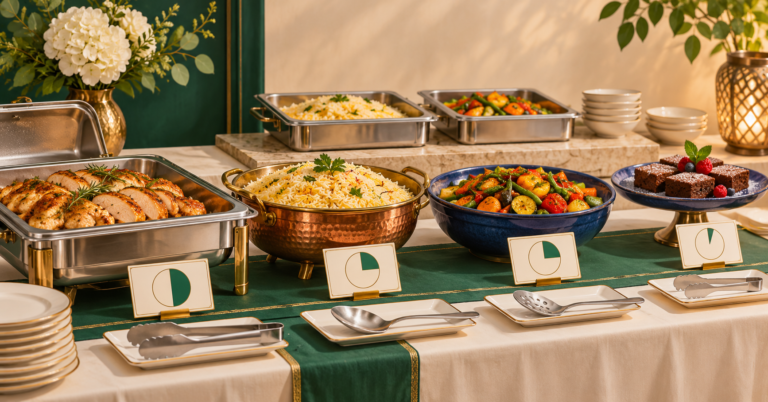
A buffet offers choice, so every guest will not take a full portion of every dish. Allocate the menu by role, estimate selection shares, define serving tools, and plan controlled refill batches. This keeps the assortment complete without treating all choices as guaranteed demand.
Create Buffet Roles Before Assigning Shares
Group dishes as mains, starches, vegetables, salads, breads, desserts, and drinks. Identify which items are alternatives and which are expected together on one plate.
Two main dishes may split demand. Rice and bread may also share the starch role. Assigning a full portion of both to every guest can overstate the buffet.
The Buffet Portion Allocation Calculator handles dish shares and portions. This guide explains how to build a coherent allocation.
Make Selection Shares Match the Menu Logic
For true alternatives, selection shares within a role should usually add to about 100%. For items guests may combine, shares may exceed 100%, but the total plate weight should still make sense.
Dish selections = expected guests × dish selection share
Dish quantity = selections × portion per selection × one reserve factor
Write why a share was chosen. Previous uptake, dietary access, item placement, price, and menu familiarity may influence the estimate.
Standardize Buffet Serving Tools
A selection share cannot control quantity when serving tools create unpredictable portions. Test every scoop, ladle, spoon, tong, or slice against the planned portion.
USDA guidance notes that standardized serving tools help provide consistent portions. Nonstandard serving spoons should be measured and staff should know how full to make them.
Label the tool with the matching dish where practical. A larger utensil moved to another pan can change portions even when the written plan remains correct.
Work Through a 100-Guest Main-Dish Allocation
Suppose a buffet for 100 guests offers chicken and a vegetarian main. The plan assigns a 75% share to chicken and 25% to the vegetarian dish, with 180 g per selection.
Base demand is 13.5 kg chicken and 4.5 kg vegetarian main. A 10% reserve raises these to 14.85 kg and 4.95 kg.
These are ready-to-serve quantities. Purchasing requires the verified yield for each recipe or ingredient. Do not apply one shared yield to different dishes.
Use Small Refill Batches Instead of One Full Display
The FDA recommends small buffet platters and replacing them with fresh dishes during service when food may not be eaten quickly. This also makes uptake easier to observe.
Set an opening display quantity and refill trigger for each dish. Keep backup food under the operation’s approved temperature and contamination controls.
Do not pour a new batch onto a partly used pan without following the safe service procedure. Quantity efficiency never overrides food safety.
Protect Dietary Access and Avoid Early Depletion
A vegetarian or other suitable dish may be popular with many guests. Protect enough for confirmed needs before treating the rest as general buffet stock.
Placement matters. A dish at the start of the line may be taken more often than the same dish placed later. Separate low demand from poor access before changing future shares.
Use clear labels and the event’s allergen controls. The allocation calculation cannot verify ingredients or cross-contact safety.
Review Pan Returns by Dish and Service Period
Record opening quantity, each refill, returned food, and discarded food by dish. One total leftover weight cannot show which selection share or portion failed.
Note when a dish ran low, whether the serving tool changed, and whether late guests saw the full menu. This context protects the next plan from a false conclusion.
Revise dish shares before increasing the overall buffet reserve. If the total was adequate but the mix was wrong, a larger total would repeat the allocation problem.
Design the Buffet Line for Fair Access
Place plates, utensils, labels, dietary options, and popular dishes so guests can move without repeatedly crossing the line. Use a second service point when one station would create a severe bottleneck.
Keep protected dietary food accessible to the intended guests before general demand can deplete it. Brief attendants on refill and escalation rules.
Record when line design changes. A dish may appear more popular because it was easier to reach, not because the portion assumption was more accurate.
Download the Event Planning Worksheet
Replace the fictional row with your own event values and preserve the units used by the calculator and production record.
Plan, Produce, and Review
Keep the exact assumptions, operational rounding, and actual result in one file.
Use the Buffet Portion Allocation Calculator
The Buffet Portion Allocation Calculator performs the matching arithmetic. This guide helps you choose and verify the inputs.
Calculate With Your Event Values
Enter your confirmed count, service specification, yield, allowance, and practical rounding boundary.
بوفے پورشن تقسیم کے عام سوالات
ہر ڈش سب مہمانوں کے لیے گنیں؟
نہیں۔ متبادل ڈشوں کے لیے سلیکشن شیئر استعمال کریں اور ساتھ کھائی جانے والی چیزیں الگ سوچیں۔
سلیکشن شیئر 100 فیصد ہونا چاہیے؟
حقیقی متبادل میں عموماً ہاں، مگر مہمان چیزیں ملا سکتے ہوں تو مجموعہ زیادہ ہو سکتا ہے۔
اسکوپ کیوں ناپیں؟
غیر معیاری چمچ یا ٹونگ تحریری پورشن سے زیادہ یا کم کھانا دے سکتے ہیں۔
چھوٹے ریفل بیچ کیوں بہتر ہیں؟
ان سے تازگی، نگرانی اور ہر ڈش کے اصل استعمال کا ریکارڈ بہتر رہتا ہے۔
ایک ڈش جلد ختم ہو تو کیا کریں؟
پہلے اس کا شیئر، جگہ اور رسائی دیکھیں، پورے بوفے کا ریزرو فوراً نہ بڑھائیں۔
Sources and Further Reading
Related Catering and Cooking Tools
More Event Planning Guides

Author and Founder