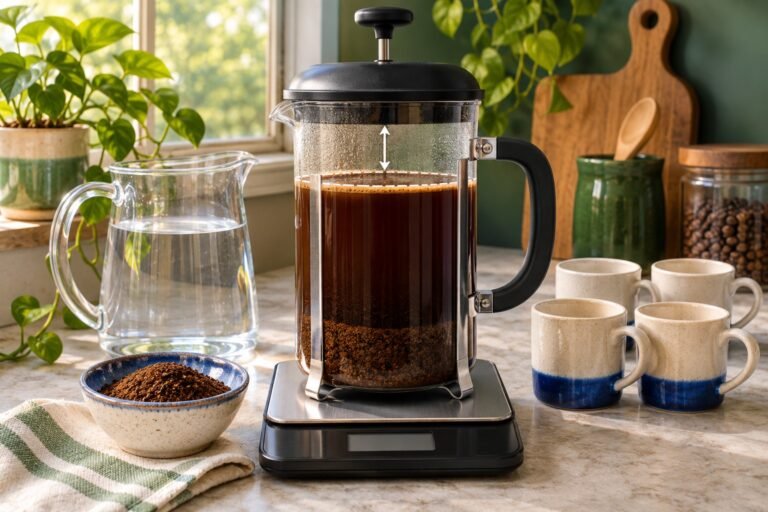
A French press label may describe nominal vessel capacity, not the safe coffee-and-water charge for every recipe. Grounds occupy space, the plunger needs room, and final beverage output is lower than brew water. A measured working-capacity test prevents overflow.
Planning the numbers? Open the French Press Coffee Quantity Calculator before filling in the worksheet.
Separate Nominal Capacity From Working Capacity
Nominal capacity is the size printed on the press or product page. Working capacity is the maximum charge you have safely tested with the grounds, lid, and plunger used in the real process.
The ESPRO French Press Coffee Brewing Guide directs users to fill to the maker’s maximum line and follow the press procedure. Treat that line and the manufacturer instructions as the equipment boundary, not a target to exceed.
Measure the vessel with water if the label is unclear, but do not assume a water-only brim test is a safe coffee charge. Grounds swell and the plunger assembly occupies space.
Calculate the Combined Charge
For a fictional plan of 60 g coffee and 900 g water, the combined charge is 960 g. If the tested working capacity is 1,100 g, the arithmetic capacity margin is 140 g.
Use compatible mass units for both inputs. Water volume can be close to water mass under ordinary kitchen conditions, but weighing both avoids mixing milliliters, ounces, and grams in one check.
The parent calculator performs the charge comparison. The operator still needs to verify the vessel line, lid fit, stir space, plunger travel, and safe handling.
Choose Ratio From a Tested Recipe
The ESPRO Coffee-to-Water Ratio for French Press presents different starting ratios by roast and encourages testing. Use the ratio from the recipe you actually brew, rather than a universal number copied without tasting or equipment checks.
When ratio changes, recalculate both coffee mass and combined charge. Adding more coffee while keeping water fixed can reduce the margin even though the nominal water quantity stays the same.
Record grind, water, coffee, steep procedure, and press model with the ratio. This keeps a preferred recipe tied to the process that produced it.
Measure Beverage Recovery Before Counting Cups
Brew water is not the same as coffee available for service. Wet grounds and the filter retain liquid, while some beverage remains below the plunger or in the vessel after pouring.
Tare the receiving server and weigh the coffee actually decanted. Divide measured beverage yield by the planned cup mass to count complete servings, then record any remainder separately.
If the fictional 900 g water charge yields 760 g beverage and cups receive 190 g, the press supplies four complete cups. Do not promise five cups from the water input alone.
Scale Group Service With Whole Press Cycles
Calculate complete press cycles from the tested beverage output, not nominal capacity. Round the number of cycles upward when a service target cannot be met by a partial count.
For twelve 190 g servings and 760 g measured output per press, demand is 2,280 g and three complete cycles are required. Schedule the cycles according to the real steep and cleanup time.
Use separate presses or smaller targets when the service window cannot support repeated cycles. The calculator plans quantities; it does not prove that one operator can brew and serve them on time.
Check the Press Before Group Service
Confirm the press model, working fill line, intact glass or body, plunger movement, coffee dose, water charge, cup target, and serving vessel before the first cycle begins.
Keep hot equipment on a stable surface and follow the manufacturer instructions. A capacity calculation does not replace safe handling or establish a brewing temperature for every coffee.
After service, record recovered beverage and complete cups. Use those observations to revise the next quantity plan instead of increasing the nominal vessel capacity.
Download the Planning Worksheet
Replace the example rows with counts from your own order or rehearsal.
اکثر پوچھے جانے والے سوالات
ورکنگ کیپیسٹی کیا ہے؟
وہ محفوظ مقدار جو اسی پریس اور پلنجر کے ساتھ آزمائی گئی ہو۔
کافی اور پانی کیوں جمع کریں؟
دونوں برتن میں جگہ لیتے ہیں۔
کیا برِم تک بھرنا درست ہے؟
نہیں، فل لائن اور بنانے والے کی ہدایات دیکھیں۔
کپ پانی سے گنیں یا تیار کافی سے؟
تیار اور ناپی ہوئی کافی سے۔
کیا ہر پریس کا نتیجہ برابر ہے؟
نہیں، برتن، گرائنڈ اور طریقہ فرق ڈال سکتے ہیں۔
Sources and Further Reading
Continue Your Coffee Workflow

Author and Founder
1 thought on “How to Size a French Press Batch Without Overfilling”