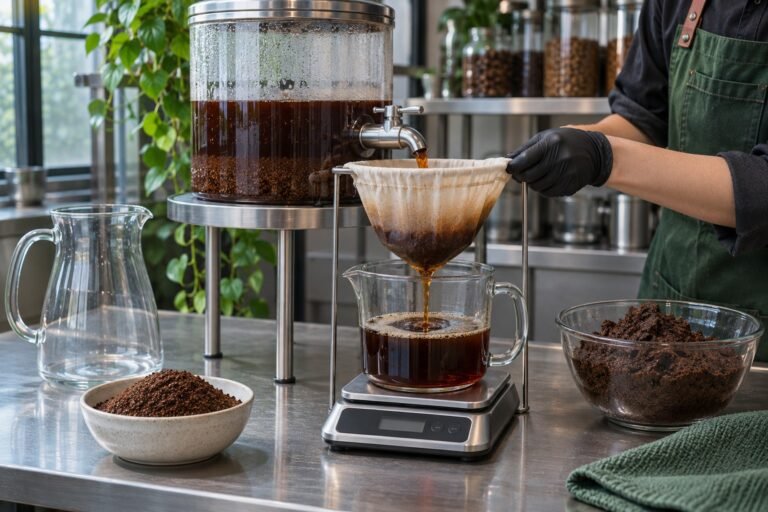
Cold-brew output is usually lower than the liquid and coffee charged into the vessel. Some liquid remains with the grounds, filter, and transfer equipment. The safest planning method is to measure recovery from the actual system instead of applying a universal loss percentage.
Planning the numbers? Open the Cold Brew Batch Quantity Calculator before filling in the worksheet.
Define Input, Recovery and Unrecovered Mass
Input water is the water charged to the brew. Recovered concentrate is the liquid collected after the chosen drain and filtration method. Their difference is unrecovered water plus any measurement or transfer loss.
Keep dry coffee mass beside these values, but do not subtract it from the liquid difference. Coffee contributes dissolved material to the beverage while wet grounds retain liquid, so the material flow is more complex than one subtraction.
The SCA Coffee Decoded: Coffee Concentrates describes concentrates as products that require clear preparation and service definitions. Name the brew and recovery stage before using its yield in a dilution plan.
Measure the Real Process
Tare the brew vessel before adding coffee and water, and tare the receiving vessel before drainage. Record the filter or bag, grind, steep conditions, drain time, pressing policy, and any transfer between containers.
The Effects of Grind, Temperature and Ratio on Immersion Cold Brew shows that grind size, temperature, time, and brewing ratio affect immersion cold brew properties. Those variables can also change how the process drains, so keep them stable during a recovery comparison.
Do not squeeze one batch and gravity-drain another, then treat the outputs as comparable. A method change can alter sediment, sensory character, and recovered mass.
Calculate a Local Recovery Result
In a fictional trial, 4,000 g water and 800 g dry coffee produce 3,050 g recovered concentrate. The water-to-recovered difference is 950 g, or 1.1875 g per gram of dry coffee.
That ratio describes this setup only. It includes liquid retained in grounds and equipment plus handling loss. It is not a scientific absorption constant and should not be copied to another brewer without trials.
Repeat the batch under the same procedure. If recovery is 3,050, 3,090, and 3,060 g, use the range and investigate large changes before choosing a planning allowance.
Plan the Next Batch From Recovered Output
Start with the ready-to-serve quantity needed, then work backward through the tested dilution ratio to required concentrate. Use the local recovery record to estimate how much input a new brew may require.
Keep predicted and actual recovery in separate columns. The prediction supports purchasing and vessel planning; the actual number updates the process record after the batch is drained.
Use the parent calculator for concentrate and water assembly. Do not add a grounds-loss allowance twice if its concentrate input already comes from measured recovered stock.
Control Storage and Labeling Separately
Loss arithmetic does not set safe steeping, storage, or service limits. Follow the recipe, equipment guidance, and applicable food-safety procedures for time, temperature, sanitation, and refrigeration.
The FDA: Are You Storing Food Safely? advises prompt refrigeration and safe storage practices for perishable foods. A calculation should not be used as evidence that a cold-brew process is safe.
Label each recovered batch with its identity and status before dilution. Record disposal, spills, and retained samples so missing mass is not silently assigned to coffee-ground absorption.
Use a Cold-Brew Recovery Checklist
Before brewing, record vessel tare, dry coffee, water, grind, filter, start time, and planned drain method. These details define the trial that the recovery result belongs to.
At drainage, keep the receiver on the scale and use the same stop rule each time. Record pressing, spills, extra filtration, and samples removed before the final recovery mass.
Afterward, compare predicted and actual concentrate. Update a planning factor only from comparable trials, and keep storage and discard controls in the separate food-safety record.
Download the Planning Worksheet
Replace the example rows with counts from your own order or rehearsal.
اکثر پوچھے جانے والے سوالات
کولڈ برو میں وزن کیوں کم ہوتا ہے؟
کچھ مائع کافی کے گراؤنڈز، فلٹر اور برتن میں رہتا ہے۔
کیا ایک مقررہ جذب شرح ہے؟
نہیں، اپنے طریقے پر بار بار پیمائش کریں۔
کیا خشک کافی کو پانی کے فرق سے منہا کریں؟
نہیں، دونوں کو الگ ریکارڈ کریں۔
ریکوری کب ناپیں؟
ایک ہی مقررہ ڈرین اور فلٹر طریقے کے بعد۔
کیا حساب حفاظت ثابت کرتا ہے؟
نہیں، حفاظت کے اصول الگ ہیں۔
Sources and Further Reading
Continue Your Coffee Workflow

Author and Founder