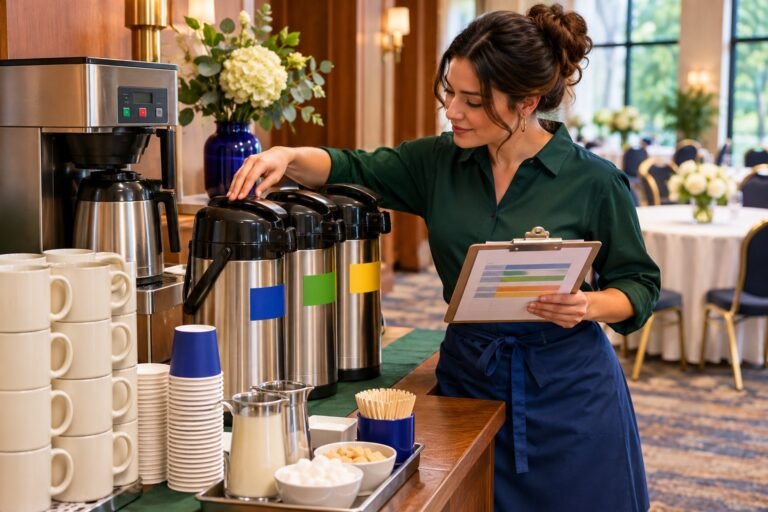
A total-volume calculation is only the first part of coffee service. Guests arrive in waves, cups are not always filled to the rim, and brewed coffee loses quality while it waits. A staggered plan connects measured batch output with the service timeline.
Planning the numbers? Open the Coffee Service Batch Calculator before filling in the worksheet.
Start With an Event-Specific Demand Assumption
Record expected guests, event type, service duration, regular and decaf split, planned servings per guest, and actual beverage mass per cup. Do not treat one attendance percentage as universal.
The Marquette University Food and Beverage Planning Tips publishes different morning and afternoon beverage planning examples. Use such references only as starting points, then replace them with records from your own events and audience.
Keep the assumption visible. If 40 guests are expected to average 1.25 servings, planned demand is 50 servings before any deliberate reserve.
Measure Cup Fill and Brewer Output
Cup label volume is not necessarily the coffee served. Measure the normal fill below the lid or rim, excluding deliberate space for milk, and record the value used in the plan.
Measure prepared beverage output from one complete brewer cycle. The Texas Tech Catering Beverage Servings shows that service providers describe gallon yield differently, which is why local cup and batch measurements are more reliable.
For a fictional 220 g cup fill and 50 servings, beverage demand is 11,000 g. If one tested brewer cycle produces 2,100 g, six complete cycles provide 12,600 g capacity.
Schedule Batches Around the Service Window
Do not automatically brew six batches before guests arrive. Record brew time, transfer time, server capacity, expected arrival wave, and the point when another batch must start.
The BUNN Serving and Holding Equipment Guide distinguishes shorter quality windows for open decanters and longer windows for closed containers. Follow equipment guidance and your service standard rather than using one holding time for every system.
A practical plan may stage an opening quantity and hold later batches as scheduled or demand-triggered starts. The exact pattern depends on brewer speed, staffing, and the event timeline.
Use a Reorder Trigger Instead of Guessing
Choose a trigger that leaves enough coffee to cover demand during the next brew cycle. If service uses 700 g during one cycle, start the next batch before available coffee falls below that amount plus a small operating margin.
Write the trigger in the service sheet and assign responsibility for checking it. A good number without a named observer can still leave the station empty.
Track actual start time, ready time, quantity transferred, and quantity remaining. This turns the next event plan into an evidence-based revision rather than another guess.
Review Waste, Shortage and Mix After Service
Record unopened reserve, beverage left in servers, discarded coffee, stockouts, and the time of peak demand. Separate regular and decaf results because their demand patterns may differ.
If 12,600 g capacity was prepared and 10,700 g was served, the capacity difference is 1,900 g. Do not call all of it waste until you distinguish unbrewed capacity from coffee actually brewed and discarded.
Update servings per guest and batch timing only after checking attendance and service conditions. One unusual event should not automatically replace a standard that works across several comparable events.
Use a Coffee-Service Readiness Checklist
Before guests arrive, confirm cup fill, opening stock, brewer output, cycle time, server labels, regular and decaf plan, reserve trigger, water supply, power, and the assigned observer.
During service, log batch start and ready times instead of relying on memory. Mark unexpected demand, equipment delay, a changed cup, or any batch that was prepared but not served.
After service, reconcile coffee brewed, served, remaining, and discarded. Keep unbrewed capacity separate so the next forecast is based on actual beverage movement.
Download the Planning Worksheet
Replace the example rows with counts from your own order or rehearsal.
اکثر پوچھے جانے والے سوالات
کتنی کافی پہلے بنائیں؟
افتتاحی ضرورت اور اگلے بیچ کے وقت کے مطابق۔
کپ کا پورا سائز استعمال کریں؟
نہیں، اصل بھری ہوئی مقدار ناپیں۔
بیچ کب دوبارہ شروع کریں؟
جب موجود کافی اگلے بریو وقت کی طلب کے قریب پہنچے۔
کیا ساری اضافی صلاحیت ضائع شدہ کافی ہے؟
نہیں، پہلے دیکھیں کیا واقعی بریو ہوئی تھی۔
اگلے پروگرام کے لیے کیا محفوظ کریں؟
حاضری، بنائی گئی مقدار، پیش کی گئی مقدار اور وقت۔
Sources and Further Reading
Continue Your Coffee Workflow

Author and Founder
1 thought on “How to Plan Coffee Service Batches Without Running Out”