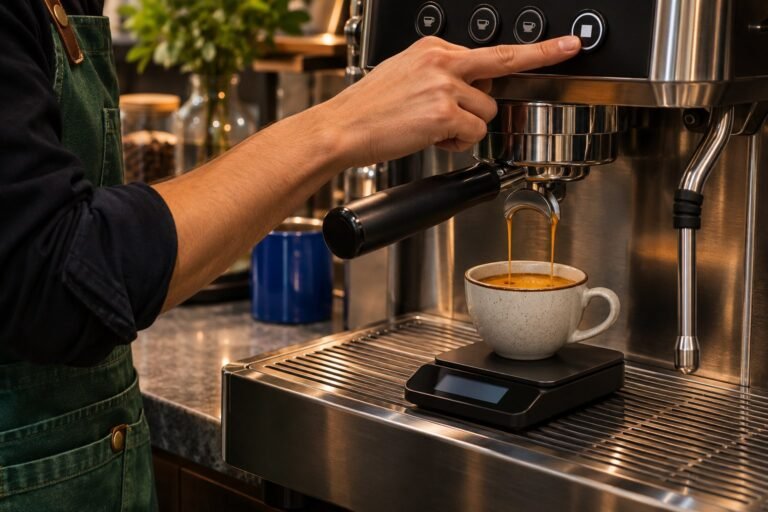
An espresso target is the beverage mass you want in the cup. The machine may continue dripping after the pump stops, so the button press and the final reading are not always the same moment. A short calibration record makes the stop point repeatable.
Planning the numbers? Open the Espresso Beverage Yield Calculator before filling in the worksheet.
Define Dose, Target Yield and Final Yield
Dose is the dry coffee placed in the basket. Target yield is the planned espresso beverage mass. Final yield is the stable scale reading after the machine and basket finish dripping into the cup.
The SCA: Defining the Ever-Changing Espresso defines brew ratio using ground coffee mass and liquid espresso mass. For a fictional 18 g dose and 1:2 ratio, the target beverage yield is 36 g.
Do not substitute cup volume for beverage mass. Crema changes volume while the scale still reports the mass used by the recipe.
Set Up the Scale Before Brewing
Place the empty cup on a scale that fits safely under the group. Tare it to zero and confirm that the cup does not touch the machine or drip tray edge in a way that changes the reading.
Keep the same cup type and scale position during a test series. Wipe water from the tray and cup base because stray liquid can add mass that did not come from the espresso extraction.
Record the dry dose separately. The parent calculator can estimate total beverage from available coffee, but the scale establishes the actual output of each extraction.
Learn the Residual-Flow Overshoot
Pull several controlled shots and note the reading when you stop the pump and the final settled reading. If stopping at 34.8 g repeatedly finishes near 36.0 g, the observed overshoot is about 1.2 g.
The La Marzocco: Dialling In With Coffee Station describes predictive control that accounts for residual drips. A manual workflow can use the same idea as a recorded stop-point offset, but it cannot promise the same automation.
Do not copy an offset between machines, baskets, coffees, or grind settings. Flow behavior changes, so treat the offset as a local observation tied to the tested setup.
Use a Small Trial Table
Record dose, target yield, pump-stop reading, final yield, shot time, coffee, grind setting, and any unusual channeling or interruption. Three comparable trials show more than one isolated result.
For final yields of 35.8, 36.1, and 36.0 g, the range is 0.3 g. If one trial finishes at 38 g, inspect the workflow before averaging it with the others.
Adjust one factor at a time. Changing the target, grind, dose, and stop point together makes it impossible to know why the final mass changed.
Separate Consistency From Taste
A repeatable 36 g output does not prove the espresso tastes balanced. Use target yield to hold one recipe variable steady while grind, time, temperature, and sensory results are evaluated separately.
If the shot reaches the target much faster or slower than the tested recipe, investigate the grind and preparation rather than extending or shortening yield automatically. A different yield changes the brew ratio.
Recheck the scale periodically and after moving equipment. Save the working stop point with the machine and recipe name so another operator can reproduce the same test.
Use a Shot-Yield Checklist
Confirm the cup is dry, the scale reads zero, the dose matches the basket plan, and the target yield belongs to the coffee being used. Record any machine preinfusion setting.
During extraction, watch the live mass without touching the cup or scale. Stop at the tested point, allow the final drops included by the procedure, and write the settled reading.
After several shots, compare final yield, pump-stop mass, and time. Keep the current offset only when comparable trials remain close enough for the service standard.
Download the Planning Worksheet
Replace the example rows with counts from your own order or rehearsal.
اکثر پوچھے جانے والے سوالات
ٹارگٹ ییلڈ کیا ہے؟
کپ میں مطلوبہ ایسپریسو کا وزن۔
کپ کو ٹئیر کیوں کریں؟
تاکہ ترازو صرف مشروب کا وزن دکھائے۔
شاٹ پہلے کیوں روکیں؟
پمپ رکنے کے بعد بھی چند قطرے گر سکتے ہیں۔
کیا ایک آف سیٹ ہر مشین پر چلتا ہے؟
نہیں، اسے اسی مشین اور نسخے پر جانچیں۔
وزن درست ہو تو ذائقہ بھی درست ہے؟
ضروری نہیں، ذائقہ الگ جانچنا ہوتا ہے۔
Sources and Further Reading
Continue Your Coffee Workflow

Author and Founder
1 thought on “How to Stop Espresso at a Target Beverage Yield”