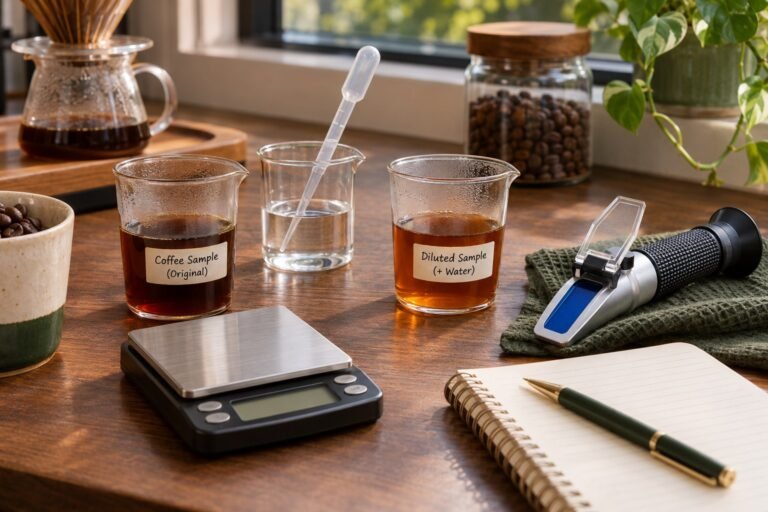
A dilution calculation predicts how much water should lower coffee strength. The test still depends on a representative starting sample, accurately weighed water, complete mixing, and a second measurement. This workflow keeps the predicted value separate from the observed result.
Planning the numbers? Open the Coffee Total Dissolved Solids Dilution Calculator before filling in the worksheet.
Decide Why the Sample Needs Dilution
Use dilution when a measured coffee sample is stronger than the target you need to test or serve. Do not add water merely to force a reading into a preferred range without recording the original measurement.
The METTLER TOLEDO: Total Dissolved Solids in Coffee explains that TDS describes coffee strength and supports extraction estimates. The number belongs to the measured beverage, so every dilution step needs its own mass and TDS record.
Confirm the refractometer model, scale, and procedure first. A coffee TDS instrument and a general Brix instrument are not automatically interchangeable, even when both display a percentage.
Record the Undiluted Sample First
Mix the source beverage gently before taking the sample. Record its code, mass, temperature condition, measured TDS, instrument model, and time. Keep this original line even if the later result is unexpected.
Use the ATAGO PAL-COFFEE Measurement Guide for the exact device procedure, including cleaning, zero checks, sample placement, and temperature limits. The calculator cannot correct a dirty prism or an unrepresentative sample.
If repeat starting readings disagree, stop before adding water. Clean the surface, remix the beverage, and repeat according to the instrument instructions until you understand the variation.
Calculate Water as a Prediction
For a fictional 100 g sample at 2.00% TDS with a 1.50% target, dissolved solids equal 2.00 g. Final mass is 2.00 divided by 0.015, or 133.33 g, so predicted water to add is 33.33 g.
Keep full precision during the calculation, then round only to a mass the scale can actually resolve. A scale reading to 0.1 g does not support an instruction such as 33.333333 g.
The calculation assumes the added water contributes no coffee solids and nothing spills or evaporates. It predicts a mixing target, not a guaranteed instrument reading.
Add Water and Mix Without Losing the Trail
Tare the receiving vessel or record its empty mass. Add the measured coffee sample, then add water gradually until the planned total is reached. Record the actual water added rather than copying the target.
Mix the entire diluted sample so the next reading represents one solution. Avoid measuring a surface layer immediately after adding water because incomplete mixing can produce a misleading value.
Use one sample code with separate stages such as original, predicted dilution, and measured dilution. This prevents the lower TDS reading from being paired with the original sample mass.
Compare Predicted and Measured TDS
Clean and prepare the refractometer again, then measure the mixed sample. In the fictional example, a result near 1.50% supports the mass record. A different result is a reason to check process details, not silently edit the original row.
Calculate the difference between predicted and measured TDS and repeat only when the device procedure allows it. Investigate spill, evaporation, tare error, incomplete mixing, sample preparation, and instrument condition.
Keep sensory judgment separate. A correctly diluted sample can still taste unsuitable, and a preferred taste does not prove that the TDS measurement or calculation was correct.
Use a Short TDS Dilution Checklist
Before starting, confirm the sample code, instrument model, clean prism, scale resolution, original mass, original TDS, target TDS, and intended water source. Missing labels are easier to fix before mixing.
During the test, write the actual final mass and any spill or transfer loss. Afterward, record the measured diluted TDS and whether a repeat reading agreed within the procedure you follow.
Archive the worksheet with the parent calculator export. This preserves both the arithmetic and the measurement evidence without turning the supporting article into a duplicate calculator guide.
Download the Planning Worksheet
Replace the example rows with counts from your own order or rehearsal.
اکثر پوچھے جانے والے سوالات
ٹی ڈی ایس کیا بتاتا ہے؟
یہ کافی میں حل شدہ مادّوں کی نسبت سے طاقت دکھاتا ہے۔
پانی کب شامل کریں؟
اصل نمونہ ناپنے اور ریکارڈ کرنے کے بعد۔
کیا ہدف ٹی ڈی ایس یقینی نتیجہ ہے؟
نہیں، یہ حسابی اندازہ ہے جسے دوبارہ ناپنا چاہیے۔
نمونہ ملانا کیوں ضروری ہے؟
تاکہ نیا ریڈنگ پورے محلول کی نمائندگی کرے۔
اصل ریڈنگ حذف کرنی چاہیے؟
نہیں، اصل اور پتلا کیا ہوا ریکارڈ الگ رکھیں۔
Sources and Further Reading
Continue Your Coffee Workflow

Author and Founder