Quick answer
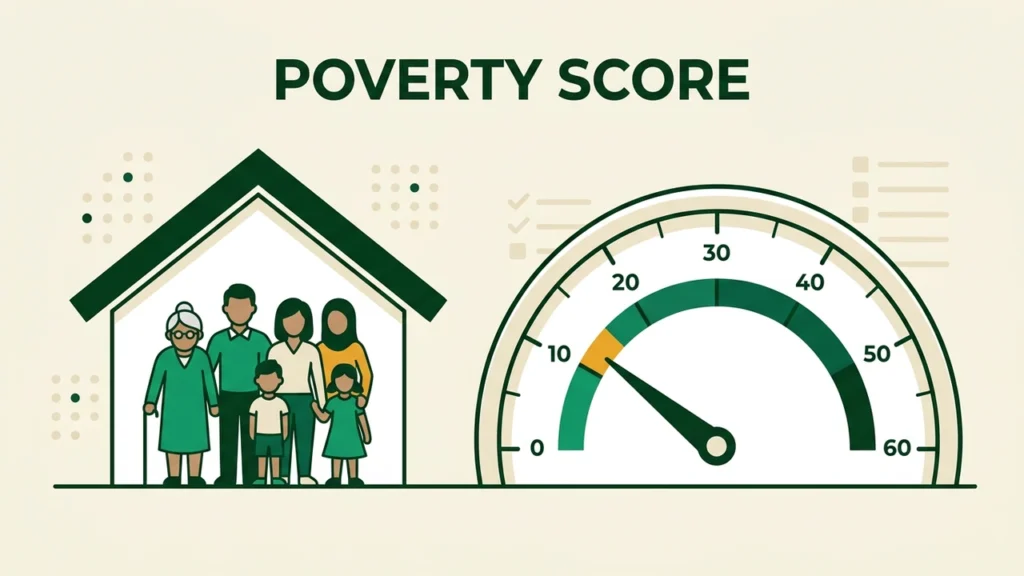
The BISP poverty score is a number generated through a Proxy Means Test (PMT). It estimates how well-off or poor a household is based on assets, income indicators, and living conditions collected during the NSER household survey.
A lower score generally suggests higher financial need, while a higher score suggests less need. BISP uses this score, along with other factors, to help decide who qualifies for support. Exact cutoff numbers can change, so always confirm your specific eligibility through official BISP channels.
Last updated: [ehsaas_modified_date]
Reviewed by: Khalil Mudassar
Table of contents
- What is the BISP poverty score?
- How is the poverty score calculated?
- What does the score mean for eligibility?
- Why your poverty score may change
- How to check your poverty score
- What to do if your score seems incorrect
- Frequently asked questions
- Understand your score, then confirm with BISP
Key information at a glance
| Item | Details |
|---|---|
| What it measures | Estimated household poverty level using a Proxy Means Test |
| Data source | NSER household survey information |
| Lower score meaning | Generally indicates higher financial need |
| Higher score meaning | Generally indicates lower financial need |
| Who assigns the score | Benazir Income Support Programme (BISP) using NSER data |
| Official BISP website | bisp.gov.pk |
| BISP helpline | Confirm through the official BISP website. |
| Last updated | [ehsaas_modified_date] |
If you have not yet checked your eligibility, this guide on why every household should check BISP eligibility explains the basics before you read about scoring.
What is the BISP poverty score?
The poverty score is a numerical estimate of a household’s economic condition. It is not based on income alone, since many households in Pakistan do not have documented income records.
Instead, BISP uses a method called the Proxy Means Test, or PMT. This method looks at visible signs of a household’s living standard, such as housing type, assets, and family size, to estimate poverty level.
This score comes from data collected during the National Socio-Economic Registry (NSER) survey. Every household that registers is asked a standard set of questions, and the answers are used to calculate the score.
How is the poverty score calculated?
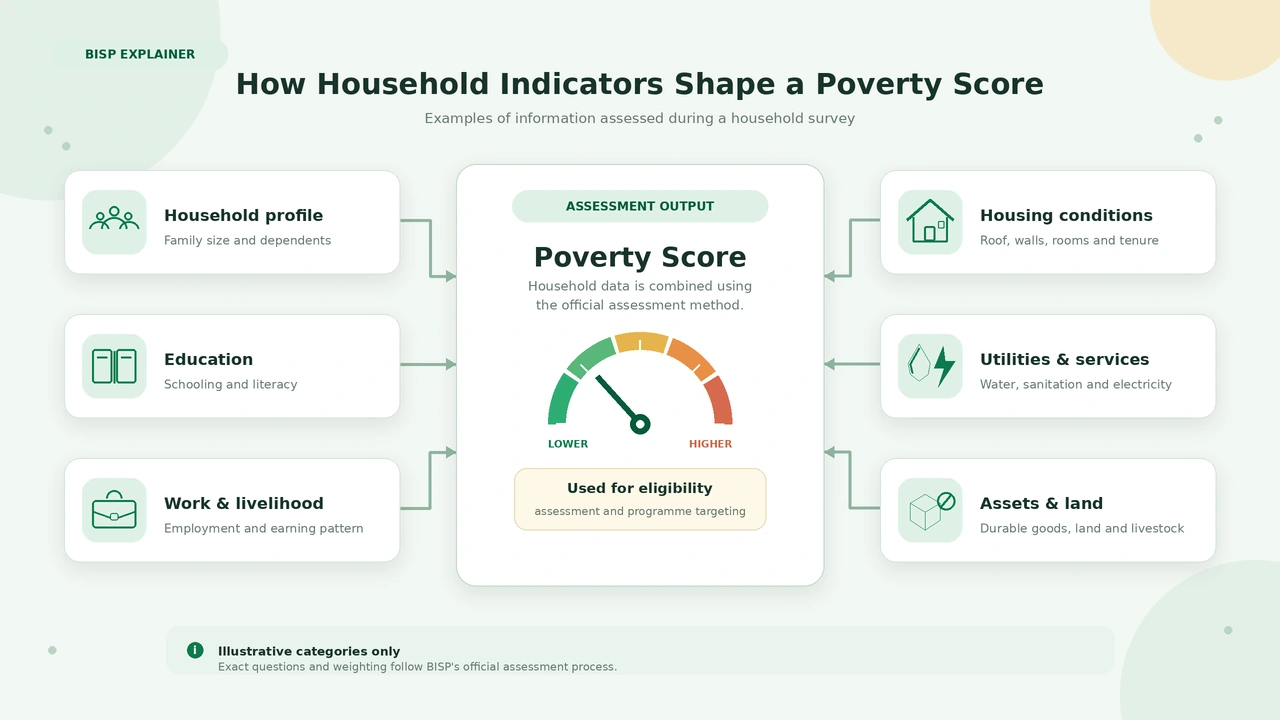
The PMT formula combines several household indicators into one number. Common factors considered include the following.
- Type of housing structure and construction material
- Ownership of land, livestock, or vehicles
- Number of rooms and household size
- Access to utilities such as electricity and gas
- Education level of household members
- Employment type of the household head
Each indicator is weighted differently in the formula. The exact weighting formula is set by BISP and NSER analysts and is not published in simple terms for the public, so this article explains the general concept rather than the precise calculation.
The result is a single score that places a household somewhere on a poverty scale. Households with fewer assets and weaker living conditions typically receive a lower score.
What does the score mean for eligibility?
In general terms, a lower poverty score suggests a household faces more financial hardship. A higher score suggests a household has relatively better living conditions.
BISP uses score ranges, often called cutoff points, to decide which households may qualify for specific programs. These cutoff points can be adjusted over time based on policy decisions and budget availability.
Because exact numeric cutoffs can change, this article does not state a fixed number as the qualifying threshold. The safest way to know if your score meets current requirements is to check directly through official BISP channels or a registration centre.
It is also worth understanding that a good score does not automatically guarantee payment, since other checks, such as identity verification through NADRA, also apply. You can read more about this connection in our guide on how NADRA supports BISP verification.
Why your poverty score may change
A poverty score is not permanent. It can change whenever your household’s situation changes or when BISP updates its survey data.
- A new NSER survey round can recalculate your score using fresh data.
- Changes in household assets, such as new appliances or vehicles, can raise the score.
- A decrease in household size or income can lower the score.
- Data corrections, such as fixing an error in an earlier survey, can adjust the score.
- Policy updates to the PMT formula itself can shift how scores are calculated nationwide.
If your household circumstances have changed significantly, it may be worth requesting an update through a Dynamic Registry Centre rather than waiting for the next full survey cycle.
How to check your poverty score
You can check basic eligibility status through the official 8171 service when it is available. This service can indicate whether your household is currently listed as eligible, though it may not always display the exact numeric score.
For a full walkthrough of the registration and status process, see this guide on BISP 8171 registration and this related article on checking your Ehsaas program status.
If the online result seems unclear, visiting your nearest BISP office in person is the most reliable way to get a direct explanation of your household’s status.
What to do if your score seems incorrect
If you believe your household’s poverty score does not reflect your real situation, you have options to raise this with BISP directly.
- Visit your nearest BISP Tehsil Office or Dynamic Registry Centre.
- Explain the specific household details you believe are inaccurate.
- Provide supporting documents, such as proof of reduced income or increased household size.
- Request a re-survey or data correction if one is available for your case.
- Ask for a written or verbal confirmation of the next steps and expected timeline.
Processing times for corrections can vary, so it is best to ask BISP staff directly rather than relying on unofficial estimates. Avoid paying anyone who claims they can guarantee a lower score or faster approval.
[TABLE: Common poverty score situations and recommended next steps]
| Situation | Recommended next step |
|---|---|
| Score seems too high despite hardship | Visit a BISP centre and request a review |
| Household details are outdated | Request an update at a Dynamic Registry Centre |
| Never surveyed before | Register through the official BISP or 8171 process |
| Score changed after a new survey | Ask BISP staff to explain the updated result |
Frequently asked questions
What is the BISP poverty score?
It is a number generated through a Proxy Means Test that estimates a household’s poverty level using survey data. BISP uses this score, along with other checks, to help decide eligibility.
How is the poverty score calculated?
It is calculated using household indicators such as housing type, assets, education, and employment, collected during the NSER survey. These indicators are combined using a formula set by BISP and NSER analysts.
Does a lower score always mean I will receive payments?
A lower score suggests higher financial need, but it does not guarantee automatic approval. Other checks, including identity verification, also apply before payments are confirmed.
Poverty score explained in Urdu for BISP, kya iska matlab hai?
Poverty score ek number hai jo aapke ghar ke halaat, jaise makan, saman, aur kharch ka andaza laga kar banaya jata hai. Yeh score BISP ko yeh samajhne mein madad deta hai keh koi ghar kitna zyada zaroorat mand hai.
Can my poverty score change over time?
Yes, your score can change if your household assets, income, or family size change, or if BISP conducts a new survey. Data corrections can also affect the score.
How can I check my current score or status?
You can check basic status through the official 8171 service or by visiting a BISP office in person. The online result may not always show the exact numeric score.
What should I do if I think my score is wrong?
Visit your nearest BISP office and request a review, bringing any supporting documents about your household situation. Avoid unofficial agents who claim they can change your score for a fee.
Is the poverty score the only factor in BISP eligibility?
No, the score is one major factor, but identity verification and program-specific rules also play a role. Meeting one requirement does not automatically confirm full eligibility.
Understand your score, then confirm with BISP
- Remember that the poverty score comes from PMT calculations using NSER survey data.
- A lower score generally reflects greater financial need, but exact cutoffs can change.
- Check your current status through the official 8171 service or a BISP office visit.
- Request a review at a BISP centre if your household situation has changed.
- Always confirm final eligibility decisions through official BISP channels, not unofficial sources.
To continue learning about the registration process itself, read this guide on how to apply for BISP.
Disclaimer: This article is for informational purposes only. Ehsaasration.pk is not an official government website. Confirm eligibility and score details through BISP or another relevant government authority before taking action.