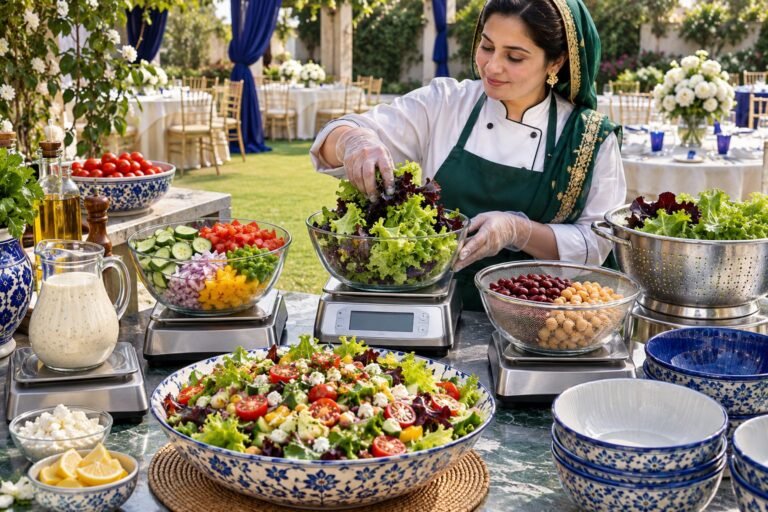
Salad quantity depends on more than lettuce weight. The finished bowl includes leaves, vegetables, fruit, beans, cheese, garnish, and dressing, while trimming and draining reduce purchase weight. Build the finished portion first, then convert each ingredient into a purchase quantity.
Define the Finished Salad
Write every ingredient and the amount that belongs in one serving. A leafy side salad differs from a grain salad, fruit salad, pasta salad, or protein-rich main salad.
Choose weight or volume that matches the ingredient. Leaves can vary greatly in volume after cutting, while beans and chopped vegetables may be easier to measure by drained weight.
The Salad for Guests Calculator scales the finished quantity. This guide explains how to convert the ingredient mix into purchase amounts.
Estimate the Selection Share
Not every buffet guest will take every salad. Estimate the share expected to select this salad when several sides are offered.
Protect verified dietary access before releasing the remaining salad to general service. A suitable option may be popular with many guests, so availability should not rely only on the protected count.
Finished salad demand = guests × selection share × finished portion × (1 + allowance rate)
Convert Finished Ingredients to Purchase Form
Leaves may lose outer parts, stems, damaged areas, and water during preparation. Canned ingredients may require draining. Whole vegetables may be trimmed and cut.
Use a yield that matches the purchased and served forms. USDA’s Food Buying Guide explains that product quality, handling, equipment, method, and serving tools can affect yield.
Divide the usable quantity needed by the yield fraction to estimate purchase quantity. Test local products when results differ consistently.
Work Through a 60-Guest Example
Suppose 60 guests have an 80% chance of selecting a 140 g side salad. Base finished demand is 6.72 kg.
A 5% allowance raises finished demand to 7.056 kg. If the tested ingredient mix is 55% leaves, 30% chopped vegetables, 10% drained beans, and 5% garnish, allocate each finished amount by that share.
Convert each component through its own trim or drain yield. Do not apply one lettuce yield to tomatoes, beans, and cheese.
Keep Dressing and Wet Ingredients Separate
Choose whether dressing is tossed, lightly coated, or served on the side. Measure dressing per finished portion rather than pouring by eye.
Wet ingredients, salt, and dressing can soften leaves and release water. Prepare and combine the salad according to the tested recipe and service schedule.
Record dressing returns separately. A full bottle on the table is not the same as dressing consumed.
Use Small Refill Bowls
Prepare clean refill batches and place only the amount expected to move through service. Smaller bowls can protect appearance and make returns easier to measure.
Follow the operation’s approved temperature, contamination, and replacement procedures. FDA guidance for buffets emphasizes safe holding and fresh replacements.
Replace a nearly empty serving bowl with a fresh bowl. Keep each batch separate for service and tracking.
Review Ingredient-Level Returns
Record prepared salad, bowls issued, returns, dressing used, and waste. If guests leave one ingredient behind, note the mix rather than calling the whole portion too large.
Compare opening placement, labels, serving tool, and menu competition. A salad placed late in the line may be selected less often.
Adjust selection share, finished portion, ingredient mix, and refill timing separately. Each change solves a different problem.
Avoid Common Salad Planning Errors
Do not calculate every ingredient from the same trim yield. Whole lettuce, ready-to-use leaves, tomatoes, cucumbers, canned beans, and cheese enter the kitchen in different forms.
Avoid dressing the full quantity too early. A measured refill plan can keep later bowls closer to the tested texture while making returns easier to track.
Do not assume a low return means the portion was perfect. Guests may have taken less because bowls were empty, labels were unclear, or the salad was placed after other sides.
Keep food-safety controls outside the quantity formula. Washing, storage, handling, temperature, and replacement procedures must follow the operation’s approved process.
Build a Repeatable Production Record
Write the purchase form, usable ingredient weight, finished mix, dressing amount, bowl size, and refill time for every test. Add the date, supplier or product description, equipment, and person who measured the result.
Use the same units throughout one calculation and label every switch between purchase form and ready-to-serve form. Photographs can support the record, but they should not replace measured weights, volumes, or counts.
When a later event produces a different result, compare one checkpoint at a time. This protects a useful tested yield from being replaced by an unexplained guess.
Download the Guest Quantity Worksheet
Replace the fictional row with your own measured portion, tested yield, guest count, allowance, and actual service result.
Plan, Produce, and Review
Keep exact demand, operational rounding, and real returns in one file.
Use the Salad for Guests Calculator
The Salad for Guests Calculator performs the matching arithmetic. This guide helps you select and verify the inputs.
Calculate With Your Guest Count
Enter the menu role, portion, tested yield, and practical rounding boundary.
Open the Salad for Guests Calculator →مہمانوں کے لیے سلاد کے عام سوالات
صرف لیٹش کا وزن کافی ہے؟
نہیں۔ مکمل سلاد میں تمام اجزا اور ان کی تیار مقدار شامل کریں۔
ہر مہمان سلاد لے گا؟
ضروری نہیں۔ دوسرے سائیڈز کے ساتھ حقیقی سلیکشن شیئر استعمال کریں۔
ٹرمنگ ییلڈ کیسے لگائیں؟
ہر خریدے گئے جزو کی قابل استعمال مقدار کے مطابق الگ ییلڈ لگائیں۔
ڈریسنگ کب شامل کریں؟
آزمودہ ریسپی اور سروس وقت کے مطابق، تاکہ سلاد پانی نہ چھوڑے۔
چھوٹے ریفل باؤل کیوں؟
ان سے تازگی، نگرانی اور اصل واپسی کا ریکارڈ بہتر ہوتا ہے۔
Sources and Further Reading
Related Guest and Catering Tools
Plan the Rest of the Menu

Author and Founder