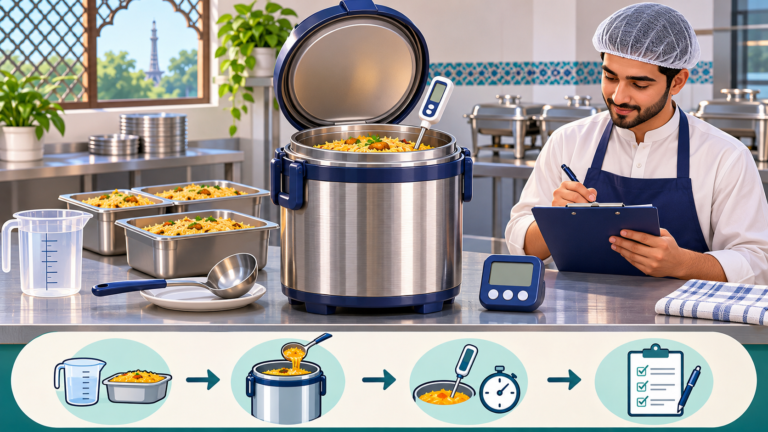
A food thermos can hold the calculated volume and still fail during service because the lid displaces food, the last portion is hard to reach, opening changes heat loss, or the filled unit is too heavy to handle. A controlled trial should measure usable capacity, portion yield, service pace, and required temperature controls as separate results.
Confirm the Exact Thermos and Intended Service
Record the manufacturer, model, stated capacity, inside dimensions, lid, gasket, tap or opening, handles, and maker instructions. Note whether the unit is intended for hot food, cold food, beverages, or a narrower use.
Define the menu item, starting condition, expected service length, opening frequency, portion tool, location, and cleaning process. Rice, soup, daal (دال), and a cold dessert behave differently inside the same vessel.
Inspect the body, seal, handles, and interior before testing. A damaged or hard-to-clean unit should not be accepted merely because its volume is correct.
Measure Working Volume and Portion Yield
Verify basic volume with measured water, then find the lower working line that allows the lid to close without touching food. Record the space lost to the lid, insert, spout, or serving clearance.
Load the real food and serve it with the normal ladle or scoop. Count full portions and measure residue that cannot be reached consistently. The last difficult serving should not be counted as a reliable portion.
The Thermos Service Quantity Calculator performs quantity arithmetic after you establish usable volume and portion size. It cannot test heat retention, access, or handling.
Set Up a Controlled Temperature Trial
Follow the manufacturer’s preparation instructions and the operation’s approved food-safety plan. Measure food temperature with a suitable calibrated thermometer at the locations and intervals required by that plan.
FDA’s model Food Code states that time and temperature control for safety food is generally held hot at 57°C or 135°F or above, with stated exceptions. Local requirements and the approved process control the actual operation.
Record the starting food temperature, fill time, closure time, each check, opening event, ambient conditions, and corrective action. Do not use an infrared surface reading as a substitute when the approved method requires internal food temperature.
Simulate the Real Opening and Serving Pattern
A sealed unit can retain heat differently from one opened repeatedly. Reproduce the expected service pattern with the normal lid-open time and portion tool.
Check food from representative positions without stirring first when the monitoring procedure requires the coldest or most vulnerable location. Record time spent open and any lid left partly engaged.
Repeat the trial at least three times. Use the shortest passing service window rather than the best isolated result.
Check Filled Weight, Access, and Cleaning
Weigh the empty thermos and the normal working load. Test the route with a cool load, including carts, stairs, doors, stands, and the landing surface.
OSHA ergonomics guidance supports reducing heavy handling and using mechanical help where practical. A smaller thermos or more frequent replacement can be better than one vessel staff cannot control.
After the trial, follow the maker’s cleaning procedure and inspect the gasket, corners, tap, and lid. Record parts that trap food or extend changeover time.
Separate Capacity From Food-Safety Approval
A capacity article cannot validate cooking, reheating, cooling, holding, or shelf life. Those controls require local rules, a qualified plan, suitable equipment, monitoring, and corrective actions.
FDA consumer guidance recommends an insulated container for hot food outdoors, but commercial catering must follow applicable requirements. Do not copy a consumer time limit into a business process without review.
Link the capacity worksheet to the required temperature record. Stop and follow the approved corrective action when a check falls outside its limit.
Avoid Common Thermos Test Errors
- Using label volume: measure the lid and service clearance.
- Testing water only: load the real food.
- Keeping it sealed: simulate normal serving.
- Checking one spot: follow the approved monitoring method.
- Ignoring filled weight: test the route with a cool load.
Repeat the trial after the thermos, menu, fill level, starting condition, route, or service pattern changes.
Build a Repeatable Test Record
Use the downloadable CSV for at least three comparable trials. Record the exact tool or container ID, food, planned setting, measured result, operator, route or service condition, failures, corrections, and final decision.
Change one factor at a time when possible. When the food, tool, method, staff, and service conditions all change together, the cause of a result is unclear.
Keep failed trials and photographs when they explain the accepted limit. A failed test helps the next person avoid repeating the same setup.
Ask another trained person to repeat the approved method from the written record. Improve the instruction when the result depends on verbal coaching.
Use a practical range when normal variation makes one exact number misleading. Record who approved the standard and when it must be reviewed.
Repeat the trial after any meaningful change to the product, tool, equipment, route, supplier, or service process.
Download the Test Worksheet
Open the CSV in a spreadsheet and replace the example row with measurements from your own controlled trial.
Keep the Test Traceable
Record the setup, result, failure, correction, and approved standard.
Use the Thermos Service Quantity Calculator
The Thermos Service Quantity Calculator performs the matching arithmetic. This article covers the physical test and operating evidence a calculator cannot observe.
Calculate With Measured Inputs
Complete a real trial, then enter the verified volume, portion, count, or service rate.
فوڈ تھرموس کے عام سوالات
لیبل والا حجم کافی ہے؟
نہیں۔ ڈھکن، خالی جگہ اور آخری مشکل پورشن کے بعد قابل استعمال حجم ناپیں۔
صرف گرم پانی سے ٹیسٹ کر سکتے ہیں؟
پانی ابتدائی جانچ ہے، مگر اصل کھانے کے ساتھ پورشن اور درجہ حرارت بھی چیک کریں۔
درجہ حرارت کہاں ناپیں؟
منظور شدہ فوڈ سیفٹی پلان اور مقامی قانون کے مطابق مناسب جگہوں پر ناپیں۔
تھرموس بار بار کھولنے سے کیا ہوتا ہے؟
سروس کا حقیقی اوپننگ پیٹرن ہیٹ ریٹنشن بدل سکتا ہے، اس لیے اسے ٹرائل میں شامل کریں۔
بھرا تھرموس کیسے منتقل کریں؟
پورا وزن ناپیں اور ضرورت کے مطابق کارٹ، چھوٹا یونٹ یا منظور شدہ مدد استعمال کریں۔
Sources and Further Reading
Related Food Service Guides
More Food Service Guides

Author and Founder
2 thoughts on “How to Test a Food Thermos for Service Capacity and Heat Retention”