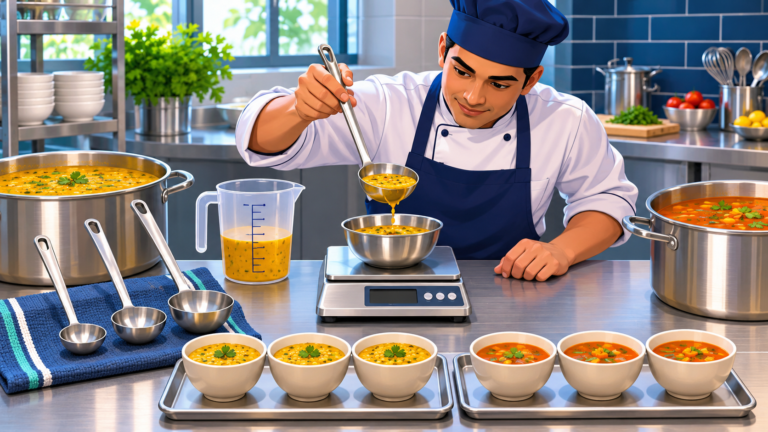
A ladle’s stamped size describes a nominal volume, not the weight of every food or the amount each person will serve. Fill angle, meniscus, drainage, solids, viscosity, and technique create variation. Calibration connects one identified ladle and one repeatable motion to a measured portion for a specific recipe.
Identify the Ladle and Recipe Standard
Assign an ID to the ladle and record its nominal size, bowl shape, handle, material, and condition. Similar ladles can deliver different amounts when their bowls or rims differ.
Start with the recipe’s approved serving size in weight or volume. The Institute of Child Nutrition’s recipe standardization guide recommends stating a practical single portion and the finished recipe yield.
Do not use calibration to choose a medical, nutritional, or regulatory portion. It checks whether the selected tool can repeat a portion already defined by the proper authority.
Verify Ladle Volume With Water
Place a measuring vessel on a level surface or tare a suitable scale. Fill the ladle using a defined technique, transfer the water, and repeat at least ten times.
Record whether the ladle is level, rounded, or filled to a visible line. Allow the same drain time each trial. Water verifies tool volume but does not prove food portion weight.
The Serving Ladle Portion Count Calculator converts verified ladle volume into theoretical portions. The physical calibration establishes the usable input.
Weigh Repeated Portions of the Real Food
Tare the receiving bowl, serve the actual recipe, and weigh at least ten portions. Stir or handle the batch according to the standardized recipe so solids and liquid are distributed as intended.
Record every result, not only the average. Calculate the range and note portions outside the approved tolerance. Thick curry, chunky soup, and smooth sauce may need different ladles or techniques.
Keep food-safety monitoring separate. Use a controlled test batch and follow required time and temperature practices during the trial.
Standardize Fill, Drain, and Delivery Technique
Write the exact motion: where the ladle enters, how it fills, whether it is leveled, the drain time, and how the portion is released. Small technique changes can shift a full service.
Test the ladle near the top, middle, and end of a batch. Record whether solids settle, the pot becomes hard to reach, or the server changes wrist angle.
Use a short visual demonstration and a written standard. Avoid vague directions such as “one scoop” when the tool and motion are not named.
Compare Operators and Service Pace
Ask at least three trained people to serve the same number of portions without seeing each other’s weights. Compare their ranges and observe technique differences.
Time a realistic service run. A method that is accurate only when performed very slowly may need another ladle, fill line, or receiving dish.
Retrain and retest after correcting the motion. Approve a practical range that different trained staff can reproduce.
Check Yield, Waste, and Customer Presentation
Serve a complete small batch and compare expected portions with actual usable portions. Record leftover food, spills, drips, and portions rejected for presentation.
A precise ladle still fails if the receiving bowl is too small or the portion splashes during handoff. Test the complete serving setup.
Use the record to connect recipe yield, ladle ID, portion range, and expected count. Recheck when recipe thickness or solids change.
Avoid Common Ladle Calibration Errors
- Trusting the stamp: verify the actual ladle.
- Testing water only: weigh the real food.
- Using one trial: repeat and keep the range.
- Ignoring technique: define fill and drain motion.
- Testing one person: compare trained operators.
Replace or recalibrate bent, damaged, or mismatched ladles before using their old standard.
Build a Repeatable Test Record
Use the downloadable CSV for at least three comparable trials. Record the exact tool or container ID, food, planned setting, measured result, operator, route or service condition, failures, corrections, and final decision.
Change one factor at a time when possible. When the food, tool, method, staff, and service conditions all change together, the cause of a result is unclear.
Keep failed trials and photographs when they explain the accepted limit. A failed test helps the next person avoid repeating the same setup.
Ask another trained person to repeat the approved method from the written record. Improve the instruction when the result depends on verbal coaching.
Use a practical range when normal variation makes one exact number misleading. Record who approved the standard and when it must be reviewed.
Repeat the trial after any meaningful change to the product, tool, equipment, route, supplier, or service process.
Download the Test Worksheet
Open the CSV in a spreadsheet and replace the example row with measurements from your own controlled trial.
Keep the Test Traceable
Record the setup, result, failure, correction, and approved standard.
Use the Serving Ladle Portion Count Calculator
The Serving Ladle Portion Count Calculator performs the matching arithmetic. This article covers the physical test and operating evidence a calculator cannot observe.
Calculate With Measured Inputs
Complete a real trial, then enter the verified volume, portion, count, or service rate.
سرونگ لاڈل کے عام سوالات
لاڈل کا لکھا ہوا حجم کافی ہے؟
نہیں۔ پانی سے حجم اور اصل کھانے سے وزن دونوں بار بار چیک کریں۔
کتنی بار پورشن ناپیں؟
کم از کم دس یکساں ٹرائل کریں اور ہر نتیجہ ریکارڈ کریں۔
لاڈل لیول رکھیں یا بھرا ہوا؟
ایک واضح طریقہ منتخب کریں اور ہر سرور کو وہی طریقہ سکھائیں۔
مختلف سرور کیوں چیک کریں؟
ہاتھ کی حرکت اور ڈرین ٹائم سے پورشن بدل سکتا ہے۔
ریسپی بدل جائے تو کیا کریں؟
گاڑھا پن یا اجزا بدلنے پر لاڈل دوبارہ کیلیبریٹ کریں۔
Sources and Further Reading
Related Food Service Guides
More Food Service Guides

Author and Founder
1 thought on “How to Calibrate a Serving Ladle for Consistent Portions”