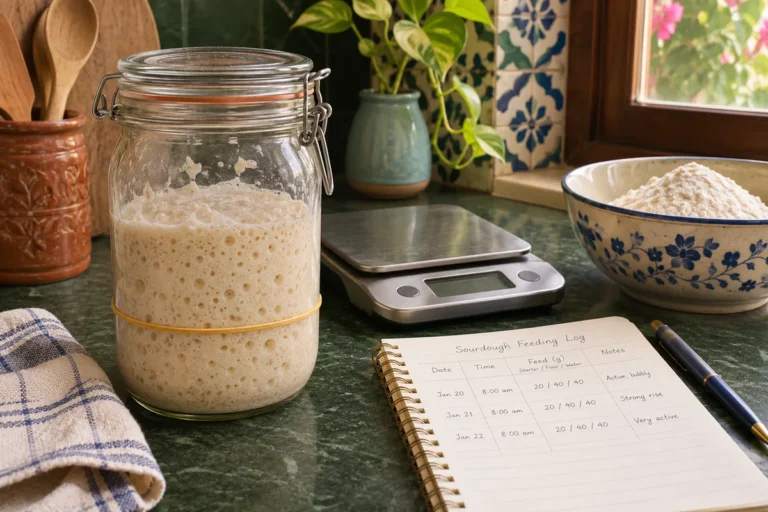
A sourdough starter is ready to bake when it rises predictably after feeding, reaches a clear peak, and repeats that behavior over several cycles. A marked jar and a short feeding log give stronger evidence than one float test or one unusually active day.
Mark the Starting Level After Feeding
Put the starter in a clean, straight-sided container after feeding. Mark the level with a rubber band or washable marker and write down the time, room conditions, flour type, and feeding ratio.
A clear starting mark lets you see the rise instead of relying on memory. Use the same jar shape when you compare one feeding with another because a narrow jar can make the same volume look taller.
Keep the lid loose enough for normal gas release while protecting the starter from contamination. Clean dried paste from the rim so old residue does not hide the current rise.
Watch the Rise, Peak, and Fall
An active starter usually climbs after feeding, reaches a highest point, and later falls. The exact hours vary with temperature, flour, starter condition, and feeding ratio, so use your own repeated record instead of copying a fixed clock time.
Near peak, the top may look rounded or domed. As the starter stops climbing, that dome often begins to flatten. A streak above the current level can show that it already rose and fell.
The University of Illinois Extension describes a ready starter as one that repeatedly doubles within about four to six hours after feeding, with bubbles and a pleasant yeasty smell. Treat that range as a useful observation point, not a guarantee for every kitchen.
Check Bubbles, Texture, and Aroma Together
Look through the side of the jar for bubbles of different sizes. A starter that only has a few surface bubbles may still be developing. A well-aerated interior shows that gas is being held throughout the mixture.
The texture should look expanded and lively rather than separated and inactive. Aroma is another clue. A healthy starter commonly smells pleasantly fermented, yeasty, fruity, or mildly sour.
Visible mold, pink or orange streaks, or a putrid smell are not readiness questions. King Arthur Baking advises discarding a starter with those contamination signs and starting again with clean equipment.
Use Repeatability as the Main Readiness Test
One fast rise can happen during an early burst of microbial activity. For a new starter, record several feeding cycles and look for similar rise behavior before relying on it to raise bread.
Use the same seed amount, flour, water, and location during the comparison. If you change all four at once, you will not know whether the starter became stronger or simply received different conditions.
A float test can be an extra observation, but it depends on how the sample is handled and how much gas it contains at that moment. A repeatable rise and peak record is more useful for planning a dough mix.
Plan the Feed Around Dough Mixing
Once you know the usual time to peak, count backward from the planned dough-mixing time. Feed early enough that the starter is active when you need it, with a small buffer for normal variation.
A larger feeding relative to the seed starter usually takes longer to mature because there is more fresh flour and water to ferment. Warmer conditions may shorten the window. Record what happened rather than treating either relationship as an exact timer.
If the starter peaks too early, adjust the next feeding schedule or ratio. Do not repeatedly feed it before it has completed a normal cycle merely because a generic schedule says that twelve hours have passed.
Download the Starter Readiness Log
Record feeding weights, starting time, peak time, rise, aroma, and notes for several cycles.
Download the Starter Readiness Log
Open the file in a spreadsheet and replace the example row with your own observations.
Use the Starter Feeding Calculator
The Sourdough Starter Feeding Calculator calculates seed starter, flour, water, total build, and discard for a chosen feeding ratio. This article owns the readiness observations that arithmetic cannot decide.
Calculate the feed, mark the jar, and record the actual peak time. After several cycles, your own log becomes a practical schedule for that starter and kitchen.
Calculate the Next Feeding
Set the feeding ratio and total amount, then track how the starter responds.
Common Starter Readiness Mistakes
- Checking only once: one rise does not show a stable pattern.
- Changing several conditions: keep flour, ratio, jar, and location steady while comparing cycles.
- Using an unmarked jar: bubbles alone do not show how far the starter rose.
- Following the clock blindly: inspect the starter when conditions change.
- Confusing contamination with hunger: discard moldy or unusually colored starter rather than trying to feed the problem away.
ساورڈو اسٹارٹر کے عام سوالات
اسٹارٹر کب تیار سمجھا جائے؟
جب وہ خوراک کے بعد بار بار واضح طور پر بڑھے، بلبلے بنائے اور تقریباً ایک ہی وقت میں چوٹی تک پہنچے۔
کیا فلوٹ ٹیسٹ ضروری ہے؟
نہیں۔ اسے اضافی اشارہ سمجھیں۔ مسلسل بڑھنے اور چوٹی کے ریکارڈ کو زیادہ اہمیت دیں۔
جار پر نشان کیوں لگائیں؟
نشان سے آغاز اور اصل اضافہ صاف نظر آتا ہے، اس لیے اندازے کی ضرورت کم ہوتی ہے۔
اگر اسٹارٹر جلدی بیٹھ جائے تو کیا کریں؟
اگلی خوراک کا وقت یا تناسب بدلیں اور نئی تبدیلی کو الگ سے ریکارڈ کریں۔
کون سی علامات خطرناک ہیں؟
پھپھوندی، گلابی یا نارنجی دھاریاں، یا سڑی ہوئی بو ہو تو اسٹارٹر ضائع کریں۔
Sources and Further Reading
Related Cooking Tools

Author and Founder