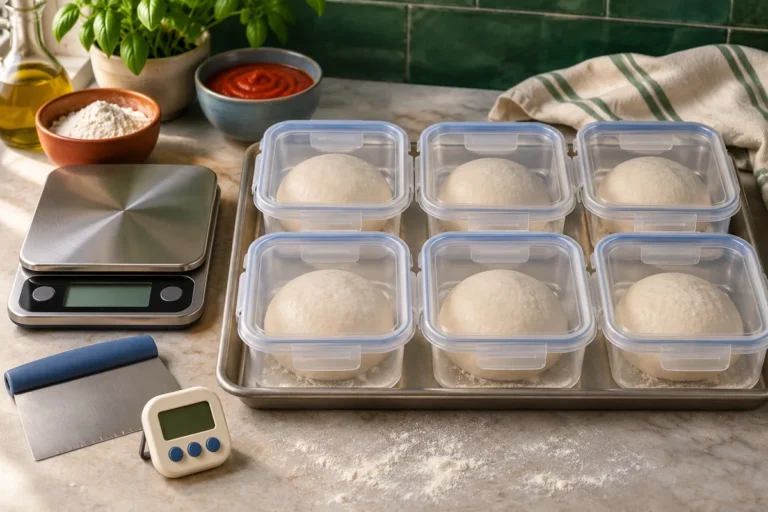
Store pizza dough balls as equal, sealed portions with enough room to expand. Label the batch, refrigerator time, ball weight, and planned use time so the dough can be assessed by its condition instead of an unlabeled guess.
Portion the Dough Before Storage
Divide the mixed dough into the planned number of balls and weigh each portion. Equal weights make proofing, opening, and baking more consistent because one ball is not carrying much more dough than another.
Shape each portion into a smooth ball with a closed seam. Avoid tearing the surface. A damaged skin can dry or spread unevenly during storage.
The parent calculator can estimate ball weight from pizza size and dough loading. This article begins after that number is chosen and focuses on handling, labeling, and storage.
Choose Containers With Expansion Room
Use food-safe containers or a dough box that protects the surface from drying. Leave enough space around each ball for normal expansion and later removal.
Place balls far enough apart that they do not merge into one mass. Manufacturer proofing guidance commonly stresses clearance around each ball and airflow around covered trays.
A light, even preparation of the container can help release the dough. Avoid pools of oil or loose flour that create a thick coating and make the surface harder to read.
Label the Batch Before Refrigeration
Write the mix time, balling time, ball weight, dough formula or batch code, refrigerator time, and planned use window. Add the actual refrigerator temperature if you track it.
Do not rely on container position or memory when more than one batch is stored. A clear label separates a fresh test from an older batch and makes a later result useful.
Record whether the dough was balled before chilling or after a bulk rest. Those processes are not interchangeable when you compare outcomes.
Keep the Cold Chain Consistent
Move the covered dough into refrigeration according to the formula and process you are testing. Keep the refrigerator closed as much as practical and avoid stacking containers in a way that blocks normal cooling.
Proofing speed depends on dough temperature, yeast amount, formula, and time. A fixed number of refrigerator days is not a universal guarantee.
Check for normal expansion, surface condition, aroma, and handling quality. If a ball has collapsed, dried, leaked, or developed an abnormal odor, do not hide that observation by reshaping it for the record.
Temper Only What You Plan to Bake
Remove only the number of dough balls needed for the baking session. Keep the rest covered and cold so repeated warming does not become an unrecorded variable.
Allow the selected balls to temper according to the tested process. One pizza-flour supplier advises keeping boxes covered while dough warms, which limits surface drying.
Record the removal time and the condition when the dough opens well. That observed window is more useful for your kitchen than copying someone else’s exact clock time.
Download the Dough Ball Storage Log
Record ball weight, container, refrigeration time, removal time, and opening quality.
Download the Dough Ball Storage Log
Open the file in a spreadsheet and replace the example row with your own observations.
Use the Pizza Dough Ball Weight Calculator
The Pizza Dough Ball Weight Calculator estimates individual and total dough weight for a selected pizza size, count, and loading. Use it before mixing so the stored portions have a clear target.
After weighing the balls, use the storage log to connect the planned weight with the actual proof and handling result.
Plan Equal Pizza Dough Balls
Calculate the target weight for each pizza before dividing the batch.
Evaluate the Dough Before Opening It
Use the label and the dough condition together. A ball that kept its smooth skin, expanded without overflowing, and releases cleanly gives a useful storage result. Record excessive spreading, crusting, sticking, or tearing.
When the dough resists opening, note whether it was still cold or had not relaxed. When it becomes weak and collapses, record the formula, storage time, and temperature instead of assuming ball weight caused the problem.
Common Storage Mistakes
- Skipping labels: an unknown batch cannot improve the next plan.
- Packing balls too closely: merged portions lose their separate shape.
- Leaving surfaces exposed: dry skin makes opening uneven.
- Warming every ball: remove only the portions planned for that session.
- Copying a universal storage time: judge the tested formula and actual refrigerator conditions.
Photograph the labeled tray at the start and before use when a visual record would help. Use the same container type in a comparison so available space and surface exposure do not change without being noted.
پیزا ڈو بال محفوظ کرنے کے سوالات
ڈو بال الگ کیوں رکھیں؟
الگ وزن اور جگہ سے ہر بال یکساں ٹھنڈا، پروف اور کھل سکتا ہے۔
ڈبے میں کتنی جگہ چھوڑیں؟
اتنی جگہ رکھیں کہ بال پھیلیں اور ایک دوسرے سے چپک کر ایک بڑا ماس نہ بنیں۔
لیبل پر کیا لکھیں؟
بیچ، وزن، بال بنانے کا وقت، فریج کا وقت اور استعمال کا منصوبہ لکھیں۔
کیا سب بال ایک ساتھ باہر نکالیں؟
صرف مطلوبہ بال نکالیں اور باقی ڈھکے ہوئے ٹھنڈے رکھیں۔
مقررہ دن ہر ڈو کے لیے درست ہیں؟
نہیں۔ وقت خمیر، درجہ حرارت، فارمولے اور اصل ڈو کی حالت پر منحصر ہے۔
Sources and Further Reading
Related Cooking Tools

Author and Founder