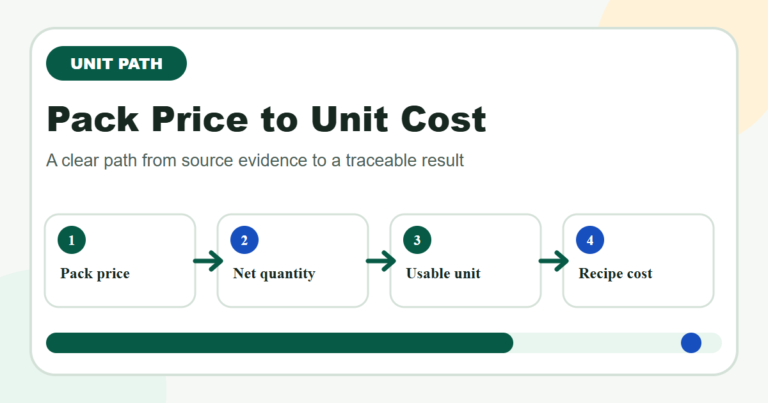
A recipe cannot use a case price until the case is reduced to the same unit used by the recipe. The correct path is pack price to net purchase quantity, then to recipe unit, then to edible or drained unit when loss applies. Skipping one boundary creates a plausible but wrong cost.
Start With Net Pack Quantity, Not Package Size
Record the number of inner packs and the net quantity in each one. A case of 12 cans at 800 g each contains 9.6 kg net, even if the shipping carton weighs more.
Use the invoice price that matches the accounting policy after documented discounts or credits. Do not subtract a discount twice when the invoice already shows the net amount.
For multipacks, confirm whether the stated quantity applies to one inner pack or the whole sale unit.
Convert to the Recipe’s Compatible Unit
Convert grams to kilograms, millilitres to litres, or pieces to a count basis before calculating recipe cost. Keep mass, volume, and count separate.
NIST states that a conversion factor changes the unit without changing the quantity. Use appropriate factors and preserve enough precision for the size of the recipe.
The Usable Ingredient Unit Cost Calculator handles purchase and usable cost after you provide consistent quantities.
Calculate Purchase Unit Cost Before Yield
Divide the net pack price by its net purchase quantity. This gives the as-purchased unit cost.
Purchase unit cost = net pack price ÷ net purchase quantity
Example: a PKR 2,400 case containing 12 kg net costs PKR 200 per kg as purchased. A recipe using 750 g uses PKR 150 before any yield adjustment.
Apply Edible or Drained Yield When It Matters
Trim, bones, peels, drained liquid, or cooking loss can reduce the amount available to the recipe. Divide purchase unit cost by the usable yield factor to find usable unit cost.
USDA’s Food Buying Guide distinguishes as-purchased quantity from edible portion and provides examples for trimmed produce, drained cans, and cooked meat. Use a local yield test when the specific product differs.
Do not apply a yield factor when the purchased form is already the same form used in the recipe.
Handle Counted Items and Mixed Packs Separately
For eggs, sachets, bread rolls, or cups, divide the pack price by the verified count. If sizes differ, a simple count may not reflect usable value.
Split mixed cases by product when each item has a different recipe use or price basis. Do not spread one average cost across items that are not interchangeable.
Record damaged or missing units through the operation’s receiving and inventory process rather than silently changing the pack size.
Keep Precision Through the Recipe Calculation
Store unit cost with more decimals than you display, then round the final ingredient or batch cost according to the approved policy. Early rounding can accumulate across many ingredients or large batches.
Show both the input pack and the normalized unit in the worksheet. Another person should be able to reproduce the conversion from the invoice.
Recalculate when pack size changes even if the selling price appears unchanged. Shrinkflation raises unit cost without changing the shelf price.
Avoid Common Pack-to-Unit Cost Errors
- Using gross carton weight: use net contents.
- Mixing grams and kilograms: convert first.
- Treating litres as kilograms: use measured density only when valid.
- Applying yield twice: identify the product form.
- Rounding too early: keep precision to the final result.
Check one conversion by multiplying the unit cost back by the pack quantity. It should return the pack price apart from final rounding.
Build a Repeatable Cost-Control Record
Use the downloadable CSV as a working record, not as a substitute for approved accounting or food-service procedures. Replace the example row with your own invoice, product specification, unit, yield, date, and approval evidence.
Keep source documents with the calculation. A second person should be able to reproduce the result without asking which pack, unit, tax treatment, or yield you meant.
Review one formula by hand and compare the result with the calculator. Investigate differences before publishing a menu price, purchase report, or production standard.
Version the record when an input definition changes. Preserve the old version so later reviews can separate a market change from a method change.
Download the Cost-Control Worksheet
Open the CSV in a spreadsheet and replace the example values with your own documented evidence.
Keep Every Number Traceable
Record the unit, source, date, boundary, calculation, and approval.
Use the Usable Ingredient Unit Cost Calculator
The Usable Ingredient Unit Cost Calculator performs the matching arithmetic. This article explains how to prepare and interpret the evidence placed into that calculation.
Calculate With Verified Inputs
Normalize the source information first, then run the calculation and save the result with its evidence.
پیک قیمت سے یونٹ لاگت کے عام سوالات
نیٹ پیک مقدار کیا ہے؟
اندر موجود اصل خوراک کی مقدار، شپنگ کارٹن یا خالی پیکج کا وزن نہیں۔
گرام کو کلوگرام کیسے بدلیں؟
گرام کو ایک ہزار سے تقسیم کریں، پھر اسی یونٹ میں قیمت نکالیں۔
لیٹر کو کلوگرام سمجھ سکتے ہیں؟
نہیں۔ دونوں الگ پیمائش ہیں، صرف درست ڈینسٹی سے تبدیل کریں۔
ییلڈ کب لگائیں؟
جب چھلکا، ہڈی، ڈرین یا تیاری کے بعد قابل استعمال مقدار کم ہو۔
راؤنڈنگ کب کریں؟
حساب میں مکمل پریسیژن رکھیں اور آخری دکھائی جانے والی رقم پر راؤنڈ کریں۔
Sources and Further Reading
Related Cooking Cost Tools
More Food Cost Guides

Author and Founder