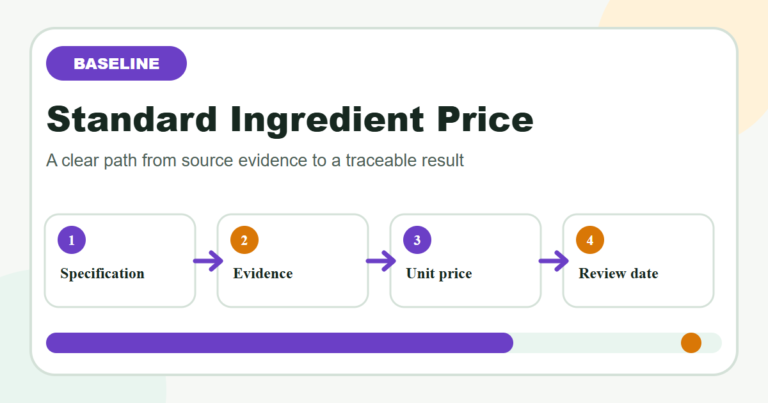
A standard ingredient price is a documented comparison point, not a permanent promise about the market. It becomes useful only when the product specification, purchase unit, freight treatment, evidence period, review date, and approval rule are clear. A vague baseline makes every later variance hard to interpret.
Define the Exact Ingredient and Purchase Unit
Write the ingredient name, grade, brand rule, pack size, net quantity, preparation form, supplier condition, and currency. “Oil” or “flour” is too broad for a defensible standard.
Normalize the price to one working unit, such as PKR per kilogram, litre, can, or piece. Do not mix gross case weight with net edible quantity.
Keep mass, volume, and count standards separate unless a measured conversion supports the exact product. NIST provides verified factors for compatible unit conversions.
Choose an Evidence Window and Baseline Method
Collect comparable invoices or approved quotes from a defined period. Exclude returns, credits, emergency purchases, and special promotions unless the policy says they belong.
A baseline may be the latest contracted price, a weighted average of recent purchases, or a budgeted price approved for a period. Name the method instead of quietly switching between them.
OpenStax explains that standard costs are budgeted amounts used to compare with actual results. It also notes that materials and labour prices do not reasonably remain constant forever.
Include Freight, Discounts, and Tax Consistently
Decide whether the standard uses invoice price, landed price, or another accounting boundary. Apply freight, rebates, discounts, and recoverable tax the same way to actual purchases.
If one supplier includes delivery and another adds it later, a simple invoice unit price is not a fair comparison. Keep the policy visible in the worksheet.
The Ingredient Purchase Price Variance Calculator compares standard and actual price. Consistent boundaries make that variance meaningful.
Calculate a Weighted Standard When Appropriate
A simple average gives every invoice equal weight. A weighted average gives more influence to larger purchases, which may better represent the period.
Weighted standard price = total comparable purchase cost ÷ total comparable quantity
Example: 100 kg at PKR 200 and 300 kg at PKR 220 produces a weighted price of PKR 215 per kg, not the simple average of PKR 210.
Set Effective Dates, Review Triggers, and Tolerances
Record when the standard starts and when it must be reviewed. Add triggers for contract changes, sustained market movement, specification changes, or repeated large variances.
A tolerance separates routine noise from an exception requiring review. The tolerance should reflect the operation’s purchasing policy and reporting needs, not an arbitrary universal percentage.
Assign an owner for each review and record the evidence checked. A scheduled review can confirm that the existing standard still represents normal purchasing conditions without forcing an unnecessary change.
Do not revise the standard merely to hide an unfavorable result. Approve the new baseline and keep the old version for audit history.
Interpret Favorable and Unfavorable Variance Carefully
OpenStax expresses materials price variance as actual quantity multiplied by actual price minus standard price. Paying less than standard may appear favorable, while paying more appears unfavorable.
A favorable price is not automatically a good purchase. Quality, yield, delivery reliability, minimum order, spoilage, and payment terms can change total value.
Investigate the reason before judging performance. Separate purchasing decisions from market movement and specification changes.
Avoid Common Standard Price Errors
- Using a vague product: define specification and pack.
- Mixing units: normalize quantity first.
- Ignoring purchase volume: use weighting when appropriate.
- Changing the boundary: treat freight and tax consistently.
- Resetting without history: version and approve changes.
Test the method on one month of invoices before making it the reporting standard.
Build a Repeatable Cost-Control Record
Use the downloadable CSV as a working record, not as a substitute for approved accounting or food-service procedures. Replace the example row with your own invoice, product specification, unit, yield, date, and approval evidence.
Keep source documents with the calculation. A second person should be able to reproduce the result without asking which pack, unit, tax treatment, or yield you meant.
Review one formula by hand and compare the result with the calculator. Investigate differences before publishing a menu price, purchase report, or production standard.
Version the record when an input definition changes. Preserve the old version so later reviews can separate a market change from a method change.
Download the Cost-Control Worksheet
Open the CSV in a spreadsheet and replace the example values with your own documented evidence.
Keep Every Number Traceable
Record the unit, source, date, boundary, calculation, and approval.
Use the Ingredient Purchase Price Variance Calculator
The Ingredient Purchase Price Variance Calculator performs the matching arithmetic. This article explains how to prepare and interpret the evidence placed into that calculation.
Calculate With Verified Inputs
Normalize the source information first, then run the calculation and save the result with its evidence.
اسٹینڈرڈ اجزا قیمت کے عام سوالات
اسٹینڈرڈ قیمت کیا ہے؟
یہ اصل خریداری قیمت کے مقابلے کے لیے منظور شدہ اور تاریخ والا بنیادی ریٹ ہے۔
کون سا یونٹ استعمال کریں؟
ایک واضح یونٹ منتخب کریں، جیسے فی کلوگرام، فی لیٹر یا فی پیک۔
سادہ اوسط یا ویٹڈ اوسط؟
خریداری کی مقدار مختلف ہو تو ویٹڈ اوسط زیادہ نمائندہ ہو سکتی ہے۔
اسٹینڈرڈ کب اپ ڈیٹ کریں؟
معاہدہ، سپیسیفیکیشن یا مسلسل مارکیٹ تبدیلی پر منظور شدہ نیا ورژن بنائیں۔
کم قیمت ہمیشہ بہتر ہے؟
نہیں۔ معیار، ییلڈ، ڈیلیوری اور ضائع ہونے والی مقدار بھی دیکھیں۔
Sources and Further Reading
Related Cooking Cost Tools
More Food Cost Guides

Author and Founder