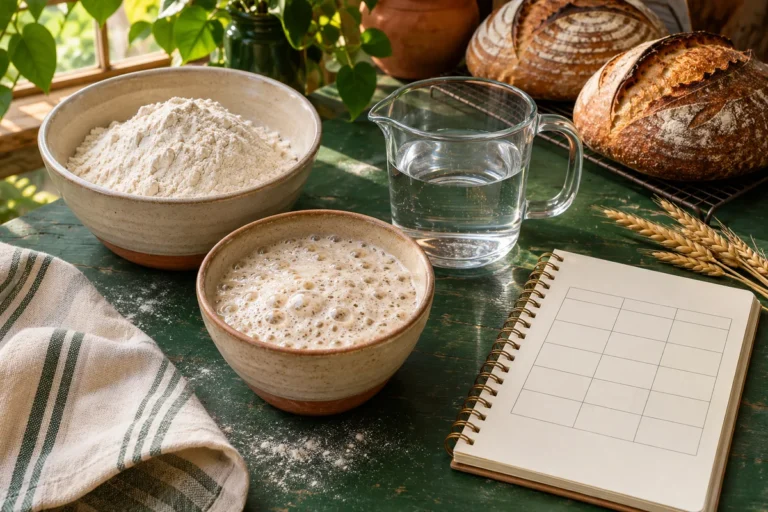
Track prefermented flour as the share of total formula flour that ferments before the final mix. Split the preferment into its flour and water, then reconcile those amounts with the final dough so nothing is counted twice.
Start With Total Formula Flour
Total formula flour includes every flour contribution in the preferment and final dough. Set that combined amount as the reference before you calculate a prefermented-flour percentage.
Do not use the weight of the whole preferment as flour. A poolish, levain, biga, or sponge also contains water and may contain yeast or other ingredients.
Write each flour type separately if the formula uses bread flour, whole wheat, rye, or another flour. The total flour row can still combine them for the percentage calculation.
Split the Preferment Into Components
Record the flour and water placed in the preferment. If you know only the total preferment weight and hydration, calculate its flour and water components before continuing.
For example, a 200 g preferment at 100% hydration contains 100 g flour and 100 g water. That does not mean 200 g of flour was prefermented.
Include seed starter contributions when the formula requires full accounting. Label any omitted carryover as an assumption rather than presenting a false exact result.
Calculate the Prefermented-Flour Share
Divide flour in the preferment by total formula flour and multiply by 100. If 150 g of a total 1,000 g flour is in the preferment, the prefermented-flour share is 15%.
This percentage describes how much flour ferments early. It is different from the preferment’s total weight as a percentage of the dough and different from the preferment hydration.
Keep those measures in separate columns. Similar labels are a common source of spreadsheet and recipe transcription errors.
Subtract Preferment Ingredients From the Final Mix
The final dough should receive only the remaining flour and water needed to reach the overall formula. Subtract the preferment flour from total flour and the preferment water from total water.
King Arthur Baking recommends an overall baker’s percentage view for formulas with preferments because it recombines all flour and water into meaningful totals.
Reconcile the preferment and final-dough columns. Their flour sum should equal total flour, and their water sum should equal total water.
Compare Formulas Without Changing Their Meaning
Prefermented-flour percentage helps compare batches of different sizes because it is based on total flour rather than kilograms or pounds. It does not, by itself, predict an exact fermentation time or flavor.
Compare formulas only after confirming that each one uses the same definition. One source may report total levain percentage while another reports prefermented flour.
Keep actual fermentation temperature, time, flour type, and maturity notes beside the percentage when you evaluate a bake.
Download the Prefermented Flour Record
Separate preferment and final-dough flour and water, then carefully verify the combined totals.
Download the Prefermented Flour Record
Open the file in a spreadsheet and replace the example row with your own observations.
Use the Prefermented Flour Calculator
The Prefermented Flour Calculator calculates prefermented flour from total flour and a target percentage, or calculates the percentage from known flour amounts.
Use the CSV record below to reconcile the preferment and final mix. The calculator owns the arithmetic while this article owns the two-stage formula record.
Calculate Prefermented Flour
Set the total flour and target share before building the preferment.
Audit a Preferment Formula Before Mixing
Read the formula from top to bottom and highlight every flour and water entry. Put the preferment contributions in one column and the final-dough contributions in another. The combined column should reproduce the original total formula without adding or losing ingredients.
Check hydration after recombination. If the preferment water was counted once inside the preferment and again as final-dough water, the displayed hydration will be too high. If the preferment flour was left out of total flour, the percentages for salt and other ingredients will also be distorted.
Common Accounting Mistakes
- Using preferment weight as flour: split it into components first.
- Mixing definitions: distinguish preferment percentage from prefermented-flour percentage.
- Ignoring seed carryover: label the assumption when full accounting is unavailable.
- Subtracting only flour: remove preferment water from the final mix too.
- Comparing unreconciled formulas: verify total flour and water before judging differences.
Also check the formula total after salt, yeast, fat, sugar, and other ingredients are restored. Prefermented flour changes where part of the flour is fermented, but it should not silently change the overall batch size. Save both the planned and actual preferment weights when transfer loss matters. This keeps a production note separate from the mathematical formula.
پری فرمنٹڈ آٹے کے عام سوالات
پری فرمنٹڈ فلور کیا ہے؟
یہ کل فارمولے کے آٹے کا وہ حصہ ہے جو آخری مکس سے پہلے خمیر ہوتا ہے۔
پورا لیوین آٹا کیوں نہیں ہے؟
لیوین میں پانی بھی شامل ہوتا ہے، اس لیے صرف اس کے آٹے والے حصے کو شمار کریں۔
فیصد کس مقدار سے نکلتا ہے؟
پری فرمنٹ کے آٹے کو کل فارمولے کے آٹے پر تقسیم کر کے سو سے ضرب دیں۔
فائنل مکس میں کیا کم کریں؟
پری فرمنٹ میں موجود آٹا اور پانی دونوں کو کل مقدار سے الگ الگ کم کریں۔
فارمولے کا حساب کیسے چیک کریں؟
پری فرمنٹ اور فائنل ڈو کے کالم جمع کریں، انہیں کل آٹے اور پانی کے برابر ہونا چاہیے۔
Sources and Further Reading
Related Cooking Tools

Author and Founder