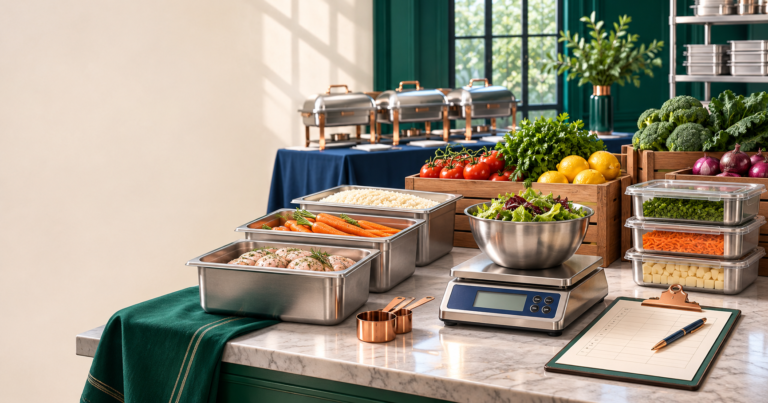
Catering quantities move through several boundaries: guest count, portions, finished recipe yield, edible ingredient quantity, purchase weight, and supplier packs. A reliable plan keeps those boundaries visible instead of hiding them inside one rough per-person estimate.
Start With a Locked Menu and Count
Quantity planning begins after the menu role and expected meal count are clear. A dish served as the main item needs a different portion from the same dish used as a side.
Separate adults, children, staff, vendors, and menu variations when the catering agreement treats them differently. Avoid using the invitation total as the production count.
The Catering Food Quantity Calculator moves from servings to purchase quantities. This guide explains the operational boundaries behind that calculation.
Move From Portions to Finished Recipe Quantity
Multiply the number of servings by the finished portion for each menu item. Use cooked weight, drained weight, or ready-to-serve volume as specified by the recipe.
Finished dish demand = planned servings × finished portion
Recipe batches = allowance-inclusive demand ÷ verified batch yield
A portion must match the recipe boundary. Do not compare a cooked serving with raw ingredient weight before applying yield.
Convert Edible Quantity Into Purchase Quantity
USDA’s Food Buying Guide separates food as purchased from the edible portion produced. Trimming, draining, thawing, cooking, and preparation can change usable quantity.
Locate or measure a yield that matches the product form and service form. Divide the edible quantity required by the yield fraction to estimate purchase quantity.
When local results consistently differ, document an in-house yield study. Supplier, quality, equipment, method, and staff practice can all change yield.
Work Through a Catering Quantity Example
Suppose 140 meals require 160 g of cooked meat each. Base cooked demand is 22.4 kg. A 5% production allowance raises it to 23.52 kg.
If the verified cooked yield from purchased meat is 75%, divide 23.52 kg by 0.75. The purchase requirement is 31.36 kg.
If cases contain 5 kg, round upward to seven cases, or 35 kg. The 3.64 kg case surplus is separate from the production allowance.
Scale Standardized Recipes, Not Ingredient Lists Alone
The Institute of Child Nutrition separates recipe verification, evaluation, and quantity adjustment. Scaling an unverified ingredient list can multiply an unknown yield problem.
Use a recipe that states ingredients, method, equipment, finished yield, portion, and tested batch size. Scale from servings or finished yield while preserving ratios.
Some large-batch processes are not perfectly linear. Pan depth, mixer capacity, heating time, evaporation, and seasoning may need a controlled production test.
Check Supplier Packs and Kitchen Capacity
Round purchase quantities to real cases, bags, cans, bottles, or individual units only after the exact requirement is known. Keep pack surplus visible.
Compare the production plan with refrigerator space, preparation tables, pans, ovens, burners, mixers, hot boxes, vehicles, and staff hours. A purchase plan can exceed practical capacity.
Schedule deliveries and batches so food enters the approved storage, preparation, transport, and holding process. The calculator does not replace safe operating procedures.
Use Production Records to Improve Future Catering
Record planned servings, prepared quantity, actual servings, leftovers, waste, substitutions, and emergency production for each menu item. Keep units consistent.
The Institute of Child Nutrition notes that production records drive ingredient adjustments when required servings differ from the recipe yield. A missing record forces the next team to guess.
Review the source of variance. Attendance errors, portion drift, unexpected substitutions, yield loss, and pack rounding need different corrections.
Build a Purchasing and Production Handoff
Give purchasing the exact product form, required quantity, supplier unit, acceptable substitute, and delivery date. Give production the standardized recipe, planned servings, batch schedule, and equipment assignment.
When a supplier changes a pack or product, recalculate yield and batches before approving the substitute. A similar name does not guarantee the same usable quantity.
Use one controlled version of the plan. Purchasing, storage, preparation, transport, and service should not operate from separate totals copied at different times.
Confirm the Final Order Before Delivery
Compare the purchase order with the latest meal count, recipe batch schedule, storage capacity, and delivery window. Confirm substitutions, short shipments, and pack-size changes before production begins.
Record who accepted each change and recalculate affected yields. This final check prevents an apparently complete delivery from creating a shortage at preparation time.
Download the Event Planning Worksheet
Replace the fictional row with your own event values and preserve the units used by the calculator and production record.
Plan, Produce, and Review
Keep the exact assumptions, operational rounding, and actual result in one file.
Use the Catering Food Quantity Calculator
The Catering Food Quantity Calculator performs the matching arithmetic. This guide helps you choose and verify the inputs.
Calculate With Your Event Values
Enter your confirmed count, service specification, yield, allowance, and practical rounding boundary.
کیٹرنگ فوڈ مقدار کے عام سوالات
خریداری وزن اور تیار وزن ایک ہیں؟
نہیں۔ تراش، نکاسی اور پکانے کے بعد قابل استعمال مقدار خریداری وزن سے مختلف ہو سکتی ہے۔
ریسپی کب اسکیل کریں؟
پہلے پورشن اور آزمودہ تیار ییلڈ واضح کریں، پھر مطلوبہ سرونگز کے مطابق بیچ بڑھائیں۔
ریزرو اور کیس سرپلس میں فرق؟
ریزرو منصوبہ شدہ غیر یقینی مقدار ہے، کیس سرپلس پورے سپلائر پیک تک راؤنڈ کرنے سے بنتا ہے۔
مقامی ییلڈ کیوں ناپیں؟
سپلائر، معیار، آلات اور طریقہ کار اصل قابل استعمال مقدار بدل سکتے ہیں۔
پروڈکشن ریکارڈ میں کیا لکھیں؟
منصوبہ، تیار مقدار، اصل سرونگز، بچا ہوا کھانا، ضیاع اور تبدیلیاں الگ لکھیں۔
Sources and Further Reading
Related Catering and Cooking Tools
More Event Planning Guides

Author and Founder