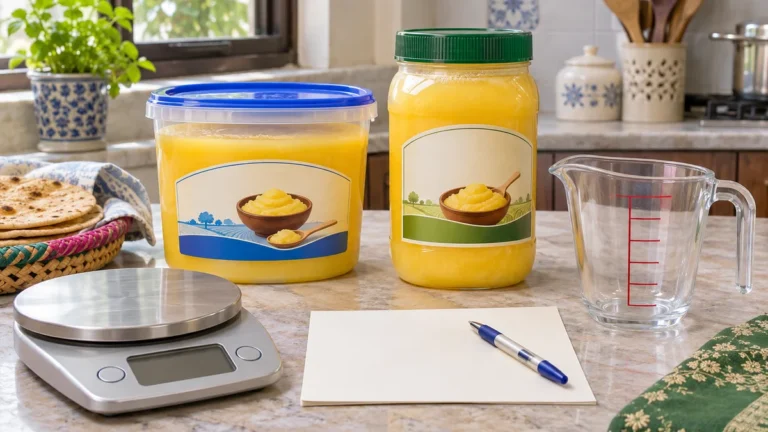
Grams and kilograms measure mass. Milliliters and litres measure volume. A ghee package may use either basis, but the numbers are not interchangeable without product-specific evidence for the exact product and conditions.
Read Mass and Volume as Different Measurements
A gram or kilogram states mass. A milliliter or litre states volume. Mass describes how much matter is present, while volume describes the space it occupies. The two unit families answer different questions.
One kilogram equals 1,000 grams, and one litre equals 1,000 milliliters. Those are conversions inside the same quantity type. There is no general rule that makes one kilogram of every food equal one litre.
Ghee packaging may use a mass statement, a volume statement, or more than one declaration required by the relevant market. Copy the exact stated quantity and unit before comparing prices.
Why a Universal Ghee Conversion Is Risky
Converting mass to volume requires density. Density can vary with product composition and temperature, and a household label may not provide the evidence needed for an exact conversion. A number copied from another product should not be treated as a verified factor.
Even when two containers look the same size, their stated quantities may differ. Package shape, empty space, and fill level are not reliable substitutes for the net quantity declaration.
If a manufacturer provides a product-specific mass and volume relationship, record the source, product, and conditions. Otherwise, compare mass-labelled offers with mass and volume-labelled offers with volume.
Compare Ghee Packages on a Shared Basis
For two mass-labelled packages, divide price by kilograms or grams. For two volume-labelled packages, divide price by litres or milliliters. Use one display basis, such as price per kilogram or price per litre.
Keep package size and total price visible beside the unit price. A unit price helps comparison, but the total purchase still depends on the package you can actually buy.
Do not use package appearance as a conversion. Do not compare a one-kilogram pack with a one-litre jar as if the stated numbers were equal. Keep the offers in separate groups when no reliable relationship is available.
Build a Ghee Package Comparison Record
The CSV records the date, product, stated quantity, stated unit, package price, currency, seller, and comparison basis. Copy the package declaration and receipt rather than rewriting one unit into another.
Add a new row when the package, seller, or price changes. Keep old rows because they show exactly which quantity basis was used at the time of purchase.
Compare Ghee Packages by the Label
Keep mass and volume offers clearly separated.
Handle Loose Ghee and Refilled Containers
For loose ghee, record the quantity shown by the seller’s measuring device and the unit used for the price. If the seller charges by kilogram, use mass. If the seller sells a stated volume, use volume.
Do not include the empty container in a household scale reading. Weigh the empty container first or press tare before filling. A home check can support your record, but it is not a legal inspection of a commercial scale.
Keep the purchase basis even if you transfer the product to another jar. The new jar’s capacity does not change the quantity or price basis of the original transaction.
Use the Ghee Calculator With Matching Units
The Ghee Quantity and Cost Calculator compares planned quantity, usable stock, package or loose-buying rules, and the price you enter. The units must describe the same quantity type.
If planned use and stock are in kilograms, use a mass-based package and price. If the workflow is in litres, keep the related inputs on a volume basis. Do not change only the package unit.
Plan a Ghee Purchase on One Clear Basis
Use the label’s unit, matching stock, the seller’s package rule, and a current price.
Avoid Common Ghee Unit Mistakes
- Treating 1 kg as 1 L: mass and volume are different quantities.
- Using jar size as net quantity: read the label instead.
- Borrowing another product’s density: require product-specific evidence.
- Converting only the package: quantity, stock, package, and price must match.
- Dropping the price basis: record whether the price is per pack, kilogram, or litre.
گھی کے وزن اور حجم کے عام سوالات
گرام اور لیٹر میں کیا فرق ہے؟
گرام اور کلو وزن کی مقدار بتاتے ہیں، جبکہ ملی لیٹر اور لیٹر حجم بتاتے ہیں۔ دونوں کو بغیر معتبر ثبوت کے برابر نہ سمجھیں۔
کیا ایک کلو گھی ایک لیٹر ہوتا ہے؟
عام اصول کے طور پر ایسا کہنا درست نہیں۔ درست تبدیلی کے لیے اسی مصنوعات کی معتبر کثافت یا واضح لیبل معلومات چاہیے۔
دو پیک کی قیمت کیسے موازنہ کریں؟
اگر دونوں کلو میں ہوں تو فی کلو قیمت نکالیں۔ اگر دونوں لیٹر میں ہوں تو فی لیٹر قیمت دیکھیں۔
کھلا گھی کیسے لکھیں؟
دکاندار جس اکائی میں ناپے اور قیمت لے، وہی اکائی اور مقدار رسید کے ساتھ لکھیں۔
کیلکولیٹر میں کون سی اکائی رکھیں؟
منصوبہ، موجودہ ذخیرہ، پیک سائز اور قیمت سب ایک ہی وزن یا حجم کی بنیاد پر رکھیں۔
Sources and Ghee Measurement Resources
Related Ration Planning Tools
Planning More Household Groceries?
Browse calculators for measured quantities, usable stock, package rules, and current costs.

Author and Founder