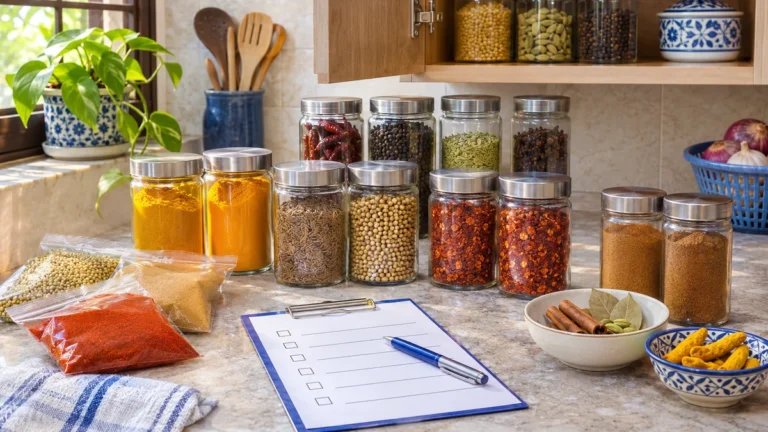
A spice cupboard audit lists each spice, its form, open stock, sealed packets, package size, and the next planned use. The goal is to prevent duplicates and missing ingredients without guessing freshness or repeating the calculator’s packet arithmetic.
Prepare a Simple Spice Cupboard Inventory Checklist
Choose one surface for the audit and work shelf by shelf. Gather jars and packets only from the shelf you are checking. This limits clutter and makes it less likely that a small packet will be missed.
Your checklist needs the spice name, form, open amount, sealed packages, labelled package size, and one action. Add a short note for the next planned dish when it explains why a low-stock item matters.
Do not turn the checklist into a shelf-life prediction. Use package storage instructions and an appropriate official food-storage resource for safety questions. The inventory’s job is to show what is present and what is missing.
Keep Single Spices, Whole Spices, and Blends Separate
Ground turmeric, whole turmeric, and a seasoning blend containing turmeric are different products. Give each one its own row. The same rule applies to whole cumin and ground cumin.
Write the product name from the label when possible. A homemade blend should have a clear household name and an ingredient note. Do not add it to the stock of one ingredient inside the blend.
Group duplicate jars only when they contain the same product and form. Two jars of ground coriander can share a total. Ground coriander and whole coriander seeds should stay separate.
Measure Open Spice Stock Without False Precision
For a useful household estimate, weigh an open jar with a tared container or use a consistent visual band such as full, half, or low. Choose one method and state it. A scale gives a better amount when the calculator will use grams.
Do not subtract the jar’s weight unless you know it or tare an empty matching container. Different glass and plastic jars can have different empty weights.
Record small amounts honestly. A scale that reads in one-gram steps cannot support a tenth-of-a-gram claim. The audit should be repeatable, not artificially exact.
Count Sealed Packets and Read the Net Amount
Count unopened packets, then copy the net amount from each label. Two packets of 50 g are not the same as one packet of 100 g when you care about opening dates or seller rules, even though their total stated mass matches.
Check whether duplicate packets have the same product name and form. A chili seasoning mix should not be counted as plain chili powder. Keep product identity ahead of package color.
The CSV stores open stock, sealed packet count, package size, unit, and shopping action. Replace the example row with your shelf findings.
Audit the Spice Cupboard
Record each product and form before making the list.
Turn the Audit Into a Short Shopping List
Choose one action for each row: buy, hold, verify, or use first. Buy means the planned use is greater than usable stock. Hold means the cupboard already covers the near-term plan. Verify means the label or amount is unclear.
Review the meal plan before marking buy. A missing spice does not need replacement when no planned dish uses it. A frequently used spice may need attention even when one small packet remains.
Keep price comparison outside the first inventory pass. Finish the cupboard count, then add current seller prices only for items on the shopping list. This reduces unnecessary work and prevents old prices from appearing current.
Use the Spice Calculator After the Cupboard Audit
The Spice Packet and Cost Calculator applies quantities, usable stock, packet sizes, and prices for the products you enter. The cupboard audit supplies cleaner stock inputs.
Enter each spice on its own line. Do not combine turmeric, chili, and coriander into one stock value. Match open stock and package size in the same mass unit before calculating packet counts.
Turn Checked Stock Into a Spice List
Bring the audited product, usable stock, planned quantity, packet size, and current price.
Avoid Common Spice Cupboard Audit Errors
- Combining whole and ground forms: give each product its own row.
- Counting a blend as one ingredient: keep seasoning mixes separate.
- Guessing jar tare weight: use a tared container or a stated estimate.
- Buying every low jar: check the next planned dishes first.
- Predicting safety from appearance: follow official storage guidance and package directions.
مصالحہ الماری کے عام سوالات
الماری کا آڈٹ کہاں سے شروع کریں؟
ایک وقت میں ایک شیلف خالی کریں۔ ہر مصالحے کا نام، شکل، کھلا ذخیرہ اور بند پیکٹ الگ لکھیں۔
ثابت اور پسا مصالحہ ایک ساتھ لکھیں؟
نہیں۔ ثابت زیرہ اور پسا زیرہ الگ مصنوعات ہیں، اس لیے ان کے لیے الگ قطار رکھیں۔
مصالحہ مکس کہاں شمار ہوگا؟
گرم مصالحہ یا سیزننگ مکس کو الگ مصنوعات لکھیں۔ اسے اندر موجود ایک مصالحے کے ذخیرے میں شامل نہ کریں۔
کھلے جار کی مقدار کیسے ناپیں؟
خالی برتن ترازو پر صفر کریں اور مصالحہ ناپیں۔ اگر ترازو نہ ہو تو واضح اندازہ جیسے پورا، آدھا یا کم لکھیں۔
کیلکولیٹر کب استعمال کریں؟
پہلے الماری کا ذخیرہ اور ضروری مصنوعات طے کریں، پھر ہر مصالحے کی مقدار، پیکٹ سائز اور موجودہ قیمت کیلکولیٹر میں ڈالیں۔
Sources and Spice Inventory Resources
View 4 Sources
- FoodSafety.gov. FoodKeeper App
- NIST. Metric Kitchen: Cookware and Tools
- FSSAI. Food Labelling and Display Regulations
- NIST. Handbook 133: Checking Net Contents of Packaged Goods
Related Ration Planning Tools
Planning More Household Groceries?
Browse calculators for measured quantities, usable stock, package rules, and current costs.

Author and Founder