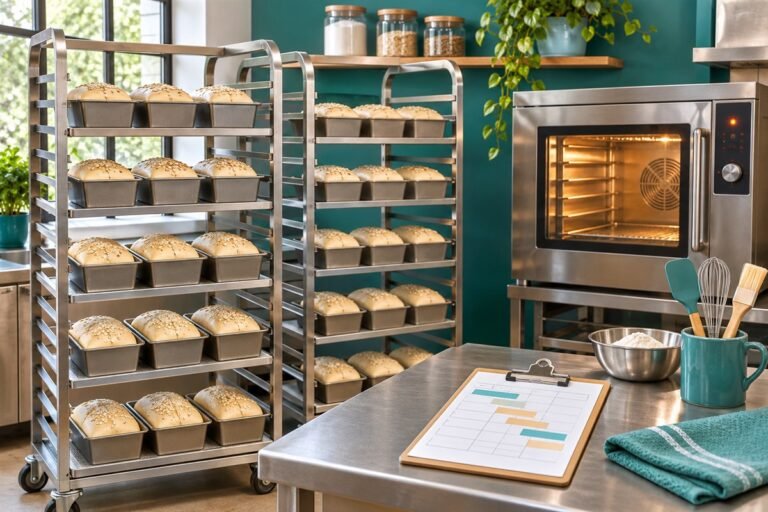
The number of loaves a dough batch can make is not always the number an oven can bake well at once. Capacity planning connects pan size, spacing, rack positions, proof timing, oven recovery, cooling space, and the people available to load and unload safely.
Separate Loaf Count From Oven Capacity
The Bread Loaf Count Calculator divides total dough by target loaf weight. It does not know the inside dimensions, rack positions, or airflow of your oven.
A batch may produce twelve loaves while the oven handles four pans per wave. The production plan therefore needs three bake waves plus loading, recovery, and unloading time.
Write both numbers before mixing. This prevents fully proofed loaves from waiting with nowhere to bake.
Measure Pans, Racks, and Safe Spacing
Measure the pan at its widest point, including handles or rims. Measure usable rack width and depth rather than the oven’s advertised outside size.
Leave space around pans for heat circulation. King Arthur’s group-baking guide warns that too many sheets or crowded pans can bake unevenly.
Dry-fit empty pans in a cold oven before production. Confirm that racks are stable and that the door closes without touching a pan.
Map Hot Spots and Rack Positions
Home ovens often heat unevenly. Test hot spots before a large bake and record which positions brown faster.
If the recipe permits rotation, plan when and how pans will move. King Arthur recommends thoughtful rack placement and, for many products, rotating front to back and between racks.
Do not open the door repeatedly without a reason. Heat loss and unsafe handling can create more variation than the planned rotation solves.
Stagger Proofing and Bake Waves
Shape loaves in groups that match oven capacity. Stagger the start of proofing so later waves do not become overproofed while the first wave bakes.
Account for oven recovery after the door opens. A full preheat before each wave helps the next group begin under similar conditions.
Use clear labels for wave number, dough weight, pan, proof start, bake start, and expected check time. Do not rely on memory during a busy session.
Plan Cooling and People Capacity
Every loaf needs a stable cooling space with airflow. Count racks and table area before mixing, not when hot bread leaves the oven.
Assign safe loading, timing, and unloading tasks when several people are involved. Keep children and unnecessary traffic away from hot racks and oven doors.
Record actual cycle time and bottlenecks. The slowest step may be shaping, proofing, cooling, or cleaning rather than oven space.
Avoid Common Multi-Loaf Planning Mistakes
- Counting dough only: calculate bake waves.
- Crowding pans: preserve heat circulation.
- Proofing every loaf together: stagger readiness.
- Ignoring recovery: restore oven conditions.
- Forgetting cooling racks: reserve landing space.
Run a smaller rehearsal with the same pan arrangement. A tested schedule is safer and more useful than a maximum theoretical count.
Build a Repeatable Kitchen Record
Use the downloadable log for at least three comparable sessions. Record measurements before starting, conditions during the process, and the result at the same checkpoint. A note such as “better” is useful only when it explains what improved.
Label every sample and add units to every number. Keep photographs, weights, temperatures, times, and equipment names beside the written result so the next decision does not depend on memory.
Before changing the next session, review the full record and identify one likely cause. Preserve the other conditions when possible. A controlled change is slower than changing everything, but it produces information that can be used again.
Include the outcome that matters to the eater or baker, not only a convenient measurement. Texture, handling, doneness, flavor, and consistency can reveal a poor result even when the timing or weight matched the plan.
If a session differs unexpectedly, mark it as an exception instead of deleting it. The exception may reveal a scale, ingredient, oven, handling, or environment problem that deserves a separate test.
When the pattern becomes stable, write a short operating rule. State the input, target sign, acceptable range, and action when the result falls outside that range.
Download the Practical Log
Open the CSV in a spreadsheet and replace the example row with your own measurements.
Keep the Plan and Result Together
A consistent record makes the next adjustment smaller and easier to explain.
Use the Bread Loaf Count Calculator
The Bread Loaf Count Calculator handles the arithmetic for this task. This article explains the observation, equipment, and process decisions the calculator cannot measure.
Calculate first, then record what actually happened. That separation keeps the article useful without repeating the complete calculator guide.
Calculate the Measured Plan
Set the quantity first, then test the process under controlled conditions.
متعدد بریڈ لوف بیک کرنے کے عام سوالات
لوف کی تعداد اور اوون کی گنجائش میں فرق کیا ہے؟
ڈو سے بننے والے لوف الگ حساب ہیں، جبکہ اوون کی گنجائش پین کے سائز، ریک اور ہوا کی جگہ پر منحصر ہے۔
پین کے درمیان جگہ کیوں چھوڑیں؟
گرم ہوا کی گردش کے لیے جگہ ضروری ہے، ورنہ کنارے اور درمیان کے لوف غیر برابر بیک ہو سکتے ہیں۔
تمام لوف ایک ساتھ پروف کریں؟
اگر اوون سب نہیں سنبھال سکتا تو پروفنگ مرحلہ وار کریں تاکہ بعد والے لوف انتظار میں زیادہ نہ پھولیں۔
اوون کے ہاٹ اسپاٹ کیسے سنبھالیں؟
پہلے خالی یا آزمائشی بیک سے جگہیں جانچیں اور ترکیب اجازت دے تو محفوظ وقت پر پین گھمائیں۔
کولنگ کی منصوبہ بندی کیوں ضروری ہے؟
گرم لوف کو ہوا والی محفوظ جگہ چاہیے، اس لیے ریک اور میز کی گنجائش بیکنگ سے پہلے گنیں۔
Sources and Further Reading
Related Cooking Tools

Author and Founder