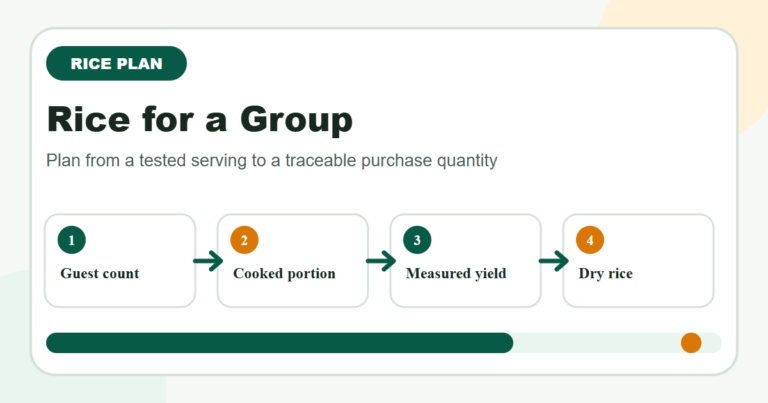
The right dry-rice quantity depends on the cooked portion you plan to serve and the yield of the exact rice and method you use. Rice served as a main dish needs a different allowance from rice served beside curry, meat, bread, and several side dishes. A measured test batch is safer than one universal rule.
Start With the Role Rice Plays on the Menu
Decide whether rice is the main starch, one of several starches, or a small side. Guests usually take less rice when naan, pasta, potatoes, or several filling dishes share the same plate.
Write the service style beside the plan. A plated meal gives tighter control than a self-service buffet, while a mixed-age family event may need separate adult and child assumptions.
The Rice for Guests Calculator uses your chosen cooked portion. It does not prescribe a universal serving.
Use Cooked Demand as the Planning Target
Guest service happens in cooked rice, but purchasing happens in dry rice. Calculate the finished demand first so the portion standard matches what reaches the plate.
Cooked demand = guests × cooked rice per guest
Dry rice needed = reserve-inclusive cooked demand ÷ measured cooked-to-dry yield
USDA Food Buying Guide values show that rice expands during cooking, but the exact yield varies by rice type and method. Keep your own measured factor with the event record.
Run a Small Rice Yield Test
Weigh a dry test amount, cook it by the same washing, soaking, water, heat, and holding method planned for service, then weigh the usable cooked rice. Divide cooked weight by dry weight.
Do not include the pot, serving tray, or discarded burnt layer. Repeat the test if the first batch does not represent normal production.
USDA’s brown-rice example reports a reference conversion from dry rice to cooked cups. The guide also treats its yields as planning values, not guarantees for every kitchen.
Work Through a Group Rice Example
A group of 60 guests is assigned 250 g of cooked rice each. Base demand is 15 kg cooked. A 10% reserve raises the target to 16.5 kg.
If the measured yield is 3.0, divide 16.5 kg by 3.0. The plan needs 5.5 kg dry rice. Six 1 kg bags provide 6 kg, leaving a pack-rounding surplus of 0.5 kg dry.
Keep reserve and pack surplus separate. The first is intentional uncertainty coverage. The second appears only because the seller uses whole packs.
Choose a Reserve From Evidence
A reserve should cover a stated uncertainty, such as late attendance, buffet variation, or an untested service. It should not be copied automatically from an unrelated event.
Record actual guests, cooked output, leftovers, and discarded rice after service. Several comparable events can show whether the reserve is too high, too low, or unnecessary.
Do not add a second hidden reserve by increasing both the guest count and the portion. Use one transparent adjustment.
Plan Cooking Capacity and Holding Separately
The rice quantity does not prove that one cooker or pot can handle the batch. Check the appliance’s practical dry-rice capacity, number of cycles, cooking time, and safe holding plan.
Large batches can cook differently from a home test. If production requires several cycles, schedule them so early rice is not held longer than the kitchen’s safe procedure allows.
Use the Rice Cooker Batch Capacity Calculator for equipment cycles. Keep food-safety controls outside the portion arithmetic.
Avoid Common Rice Planning Errors
- Using a dry portion as cooked weight: label the boundary.
- Assuming every rice triples: test the actual product and method.
- Counting reserve twice: adjust once and show it.
- Ignoring other starches: plan the whole menu.
- Rounding early: round at the purchase-pack step.
Before cooking, multiply the final dry quantity by the measured yield to confirm that it covers the cooked target.
Record Planned and Actual Group Food Quantities
Use the downloadable worksheet to keep the menu role, guest count, portion, reserve, measured yield, pack or vessel rounding, and actual outcome together. Replace the fictional row with your own event values.
After service, record actual attendance, prepared quantity, leftovers, and discarded food. One event cannot create a universal standard, but repeated comparable records can improve the next plan.
Keep the parent calculator’s export with the event sheet. A result without its input definitions is difficult to review later.
If the menu, product, service style, or equipment changes, treat the new event as a different comparison group rather than forcing it into the old average.
Download the Group Food Planning Worksheet
Open the CSV in a spreadsheet and replace every fictional value with your own measured event information.
Plan, Serve, and Review the Result
Keep the planned portion, yield, reserve, purchase rounding, and actual leftovers in one record.
Use the Rice for Guests Calculator
The Rice for Guests Calculator performs the matching quantity calculation. This article helps you choose and verify the service assumptions placed into it.
Calculate With Your Event Values
Enter the guest count, tested portion, reserve, and yield or capacity required by the tool.
مہمانوں کے لیے چاول کے عام سوالات
فی مہمان چاول کی مقدار کیسے چنیں؟
مینو، سروس کے انداز، عمر کے گروپ اور دوسری بھرپور ڈشوں کو دیکھ کر پکی ہوئی مقدار منتخب کریں۔
کیا ہر چاول کا ییلڈ ایک جیسا ہوتا ہے؟
نہیں۔ باسمتی، سیلا، براؤن رائس، بھگونے اور پکانے کے طریقے سے ییلڈ بدل سکتی ہے۔
ریزرو کتنا رکھیں؟
پچھلے اسی نوعیت کے ایونٹ، حاضری اور بچ جانے والے چاول کے ریکارڈ سے مناسب فیصد چنیں۔
خشک چاول کیسے نکالیں؟
ریزرو سمیت پکے چاول کی ضرورت کو اپنے ناپے ہوئے پکے سے خشک ییلڈ فیکٹر پر تقسیم کریں۔
کیا کیلکولیٹر فوڈ سیفٹی بتاتا ہے؟
نہیں۔ پکانے، گرم رکھنے اور بچا ہوا کھانا سنبھالنے کے محفوظ طریقے الگ سے اپنائیں۔
Sources and Further Reading
Related Group Food Planning Tools
More Guest Food Planning Guides

Author and Founder
1 thought on “How Much Rice to Cook per Person for a Group”