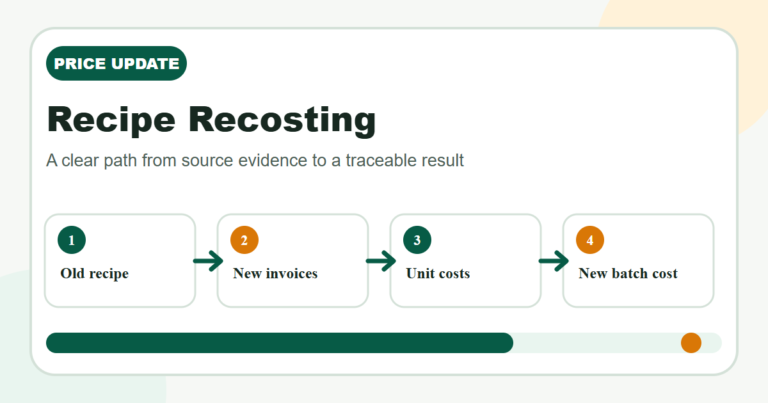
A new supplier invoice does not automatically tell you the new cost of a finished recipe. Pack size, unit, edible yield, batch yield, and rounding can all change the result. A controlled recost keeps the old version, updates one verified input at a time, and gives the new cost an effective date.
Freeze the Current Recipe Cost Baseline
Save the current recipe version before changing prices. Record its ingredient quantities, purchase units, yield assumptions, batch yield, portion count, and total cost. A dated baseline lets you explain why a later result moved.
Do not overwrite the old sheet. Give the new version a clear effective date and keep the invoice or supplier quote that supports each changed price. The standardized recipe itself should remain separate from the price file.
The Institute of Child Nutrition describes a standardized recipe as one tested for a specific kitchen. Price changes update costing, not the tested preparation method or serving standard.
Match Each Invoice Price to the Recipe Unit
Start with the invoice unit, such as a 10 kg bag, 24-can case, 1 litre bottle, or single tray. Divide the net price by the usable purchase quantity before applying it to the recipe.
Keep mass, volume, and count separate. A litre is not a kilogram unless a measured density supports that conversion for the exact product. Use NIST conversion factors when changing compatible mass or volume units.
The Recipe Batch Cost Calculator adds normalized ingredient costs. It should receive comparable recipe units, not unconverted case prices.
Update Yield Only When the Product or Process Changed
A higher invoice price is not a reason to change edible yield. Update yield when the supplier specification, trim level, drained weight, cooking method, or measured preparation loss actually changed.
USDA’s Food Buying Guide separates as-purchased food from edible portion yield. Its reference values support planning, but a documented in-house yield test can be more suitable for a specific product and method.
Keep the old and new yield factors visible. Otherwise, a price increase and a yield decrease become one unexplained number.
Recalculate Batch Cost and Portion Cost Together
Add the updated ingredient costs to find the new batch cost. Then divide by the tested number of usable portions, not the planned number before production loss.
Batch cost = sum of all updated ingredient costs
Portion cost = batch cost ÷ usable portions
Example: a batch rises from PKR 4,800 to PKR 5,160 and still yields 40 portions. The portion cost rises from PKR 120 to PKR 129, an increase of PKR 9 per portion.
Rank the Changes by Financial Impact
Sort ingredients by the change in full-batch cost, not by percentage change alone. A 40% increase on a small garnish may matter less than a 6% increase on the main protein.
Separate price effect from quantity effect. Price effect uses the old recipe quantity with the new unit price. Quantity effect records an approved recipe or yield change.
Review the top three contributors first. This makes supplier discussions and menu decisions more focused than reacting to every small movement.
Decide What the New Cost Does and Does Not Prove
The new ingredient cost supports recipe costing and food-cost percentage calculations. It does not equal net profit because labour, packaging, delivery, rent, utilities, waste, and other operating expenses may sit outside the recipe.
Do not change a menu price from one invoice without checking whether the change is temporary, seasonal, or part of a wider trend. Use the operation’s approval process.
Keep taxes, discounts, freight, and rebates consistent with the accounting policy used in the old baseline.
Avoid Common Recipe Recosting Errors
- Overwriting history: keep the old cost version.
- Using case price as unit price: normalize the pack first.
- Mixing units: convert only compatible measurements.
- Changing yield without evidence: use a measured reason.
- Using planned portions: use tested usable yield.
Recheck formulas and one sample ingredient by hand before approving the new version.
Build a Repeatable Cost-Control Record
Use the downloadable CSV as a working record, not as a substitute for approved accounting or food-service procedures. Replace the example row with your own invoice, product specification, unit, yield, date, and approval evidence.
Keep source documents with the calculation. A second person should be able to reproduce the result without asking which pack, unit, tax treatment, or yield you meant.
Review one formula by hand and compare the result with the calculator. Investigate differences before publishing a menu price, purchase report, or production standard.
Version the record when an input definition changes. Preserve the old version so later reviews can separate a market change from a method change.
Download the Cost-Control Worksheet
Open the CSV in a spreadsheet and replace the example values with your own documented evidence.
Keep Every Number Traceable
Record the unit, source, date, boundary, calculation, and approval.
Use the Recipe Batch Cost Calculator
The Recipe Batch Cost Calculator performs the matching arithmetic. This article explains how to prepare and interpret the evidence placed into that calculation.
Calculate With Verified Inputs
Normalize the source information first, then run the calculation and save the result with its evidence.
ریسپی کی نئی لاگت کے عام سوالات
پرانی لاگت کیوں محفوظ کریں؟
تاکہ نئی قیمت، مقدار یا ییلڈ کی تبدیلی واضح طور پر دیکھی جا سکے۔
کیس کی قیمت کیسے استعمال کریں؟
کیس کی خالص قیمت کو اس میں موجود قابل استعمال مقدار سے تقسیم کریں۔
کیا ہر نئی انوائس پر ییلڈ بدلیں؟
نہیں۔ ییلڈ صرف پروڈکٹ یا تیاری کے حقیقی بدلاؤ پر اپ ڈیٹ کریں۔
پورشن لاگت کیسے نکلتی ہے؟
نئی بیچ لاگت کو ٹیسٹ شدہ قابل استعمال پورشنز سے تقسیم کریں۔
نئی قیمت کب نافذ کریں؟
منظور شدہ تاریخ لکھیں اور متعلقہ انوائس یا کوٹیشن محفوظ کریں۔
Sources and Further Reading
Related Cooking Cost Tools
More Food Cost Guides

Author and Founder
2 thoughts on “How to Recost a Recipe After Ingredient Prices Change”