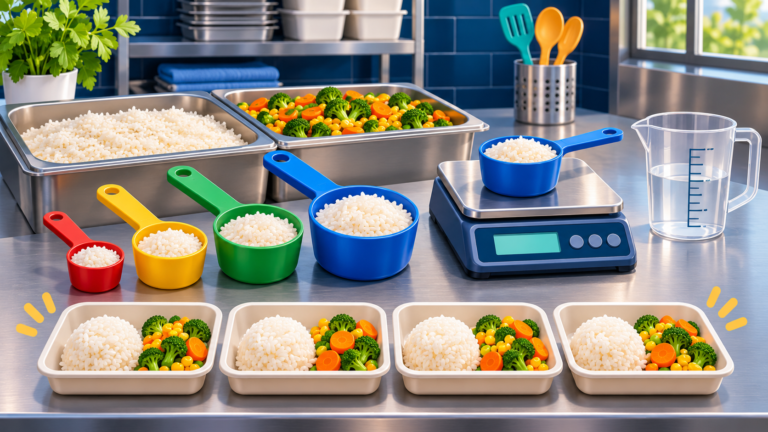
Color, number, or diameter alone does not guarantee how much a food scoop delivers. The result changes with product density, compaction, leveling, release action, and whether solids sit above the rim. A useful standard links one identified scoop, one food, and one repeatable technique to measured volume and weight.
Identify the Scoop and Intended Food
Record the scoop brand, product code, nominal size, bowl diameter, color, handle, release mechanism, and condition. Do not assume color coding is universal across manufacturers.
Define the food and target portion. Rice, mashed potato, cookie dough, salad, and chopped vegetables have different density, adhesion, and compaction.
Keep the scoop ID in the standardized recipe or service instruction. The Institute of Child Nutrition recommends listing serving size, yield, and required serving equipment in standardized recipes.
Verify Nominal Volume With Water
Tare a suitable vessel or use a level measuring container. Fill the scoop with water using one defined technique, transfer it, and repeat at least ten times.
Record the average and range. Check for a leaking release mechanism or damaged bowl. Water provides a volume reference, not the final weight of the food.
The Food Scoop Portion Volume Calculator uses a verified scoop volume for calculation. Calibration still requires the real product.
Test Level, Rounded, and Packed Fills Separately
Choose the fill style intended by the recipe. A level scoop is drawn flat across the rim, a rounded scoop rises above it, and a packed scoop adds pressure. These are different standards.
Weigh ten portions for each candidate method without mixing the results. Record how much product adheres to the scoop and whether the release mechanism clears it fully.
Use the least ambiguous technique that produces the required presentation. Avoid “heaping” unless the height and method are clearly defined and repeatable.
Measure Real-Food Weight and Release Loss
Tare the receiving container, fill the scoop, release the food, and weigh the delivered portion. Also weigh residue when sticky product remains in the bowl.
Test the beginning, middle, and end of a prepared batch. Temperature, moisture, and settling can change how the product fills and releases.
Record the delivered weight rather than only the amount loaded into the scoop. Customer portions depend on what reaches the plate or package.
Compare Operators and Receiving Containers
Ask several trained operators to portion the same food with the written technique. Compare their range, speed, wrist motion, and release action.
Test the actual plate, cup, tray, or package. A scoop can measure correctly but damage presentation, touch the rim, or overflow the receiving container.
Adjust the scoop or method when accuracy depends on one person’s special motion. The goal is a standard the team can reproduce.
Connect Scoop Results to Batch Yield
Portion a complete controlled batch and count usable servings. Compare the count with recipe yield and note leftovers, residue, broken portions, and rework.
Use weight checks at intervals during service rather than assuming the first calibration remains perfect. Define who checks, how often, and what happens outside the range.
Recalibrate when the scoop, recipe, product temperature, supplier, or preparation method changes.
Avoid Common Food Scoop Measurement Errors
- Using color alone: record the exact scoop.
- Mixing fill styles: define level, rounded, or packed.
- Testing water only: weigh the real food.
- Ignoring residue: measure delivered weight.
- Using one operator: compare the team.
Keep the calibration log beside the recipe standard so purchasing, kitchen, and service teams use the same tool definition.
Build a Repeatable Test Record
Use the downloadable CSV for at least three comparable trials. Record the exact tool or container ID, food, planned setting, measured result, operator, route or service condition, failures, corrections, and final decision.
Change one factor at a time when possible. When the food, tool, method, staff, and service conditions all change together, the cause of a result is unclear.
Keep failed trials and photographs when they explain the accepted limit. A failed test helps the next person avoid repeating the same setup.
Ask another trained person to repeat the approved method from the written record. Improve the instruction when the result depends on verbal coaching.
Use a practical range when normal variation makes one exact number misleading. Record who approved the standard and when it must be reviewed.
Repeat the trial after any meaningful change to the product, tool, equipment, route, supplier, or service process.
Download the Test Worksheet
Open the CSV in a spreadsheet and replace the example row with measurements from your own controlled trial.
Keep the Test Traceable
Record the setup, result, failure, correction, and approved standard.
Use the Food Scoop Portion Volume Calculator
The Food Scoop Portion Volume Calculator performs the matching arithmetic. This article covers the physical test and operating evidence a calculator cannot observe.
Calculate With Measured Inputs
Complete a real trial, then enter the verified volume, portion, count, or service rate.
فوڈ اسکوپ کے عام سوالات
اسکوپ کا رنگ سائز بتاتا ہے؟
ہر برانڈ میں رنگ ایک جیسا نہیں ہوتا، اس لیے پروڈکٹ کوڈ اور حجم ریکارڈ کریں۔
لیول اور راؤنڈڈ فل میں فرق ہے؟
ہاں۔ دونوں الگ پورشن دیتے ہیں، اس لیے ایک واضح طریقہ منتخب کریں۔
پانی سے ٹیسٹ کافی ہے؟
نہیں۔ اصل کھانے کا وزن، چپکاؤ اور ریلیز بھی چیک کریں۔
اسکوپ میں بچا کھانا کیسے شمار کریں؟
جو مقدار پلیٹ یا باکس تک پہنچے اسے پورشن سمجھیں اور باقی ریزیڈیو الگ ناپیں۔
دوبارہ کیلیبریشن کب کریں؟
اسکوپ، ریسپی، درجہ حرارت یا تیاری کا طریقہ بدلنے پر دوبارہ ٹیسٹ کریں۔
Sources and Further Reading
Related Food Service Guides
More Food Service Guides

Author and Founder