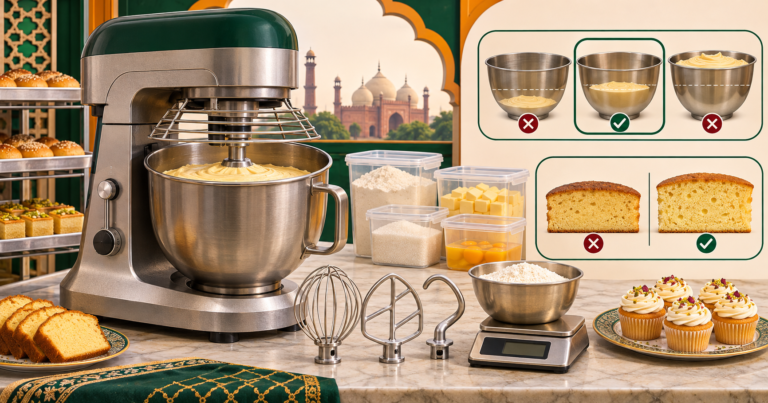
Bowl liters do not equal recipe capacity. Flour, cream, cake batter, mashed food, and egg whites have different density, expansion, mixing resistance, and attachment needs. A reliable standard starts with the mixer’s manual and confirms both small-batch reach and full-batch quality.
Identify the Exact Mixer, Bowl, and Attachment
Record mixer manufacturer, model, serial or asset ID, bowl size, bowl type, attachment, guard, and manual. Capacity tables are model specific and should not be transferred to a similar-looking machine.
Confirm that the bowl and attachment are approved for that model. Inspect attachment condition and beater-to-bowl clearance as directed by the manufacturer.
The Mixer Bowl Batch Capacity Calculator estimates volume and batch counts. The manual and real recipe test set the operating boundary.
Separate Bowl Volume From Product Capacity
A bowl marked 6.9 liters does not safely mix 6.9 liters of every product. Dense mixtures increase resistance, while whipped products expand and may climb above their starting level.
Use the manufacturer’s product-capacity chart when available. Record whether the limit is stated as flour weight, dough weight, liquid volume, eggs, cream, or another product basis.
Begin below the listed limit. Raise the load only within the manual’s instructions and after the smaller trial passes.
Test Small-Batch Beater Reach
A large bowl can fail a small recipe when the attachment does not reach or gather the product evenly. Test the smallest planned batch with the correct attachment.
Record unmixed material on the base and sides, scrape frequency, incorporation time, and finished texture. Do not adjust clearance outside the manufacturer’s procedure.
The approved operating range needs a minimum as well as a maximum. Staff should know when a hand tool or smaller machine is more appropriate.
Test Full-Batch Incorporation and Expansion
Weigh every ingredient and record the loading order, starting temperature, attachment, speed, and mixing time. Use the real recipe rather than filling the bowl with water.
Watch for dry pockets, splashing, product climbing the attachment, uneven color, excessive scrape stops, or material reaching the guard. Stop if the machine behaves abnormally.
Measure starting depth and highest observed level. The final standard should allow room for controlled incorporation and expected expansion.
Compare Finished Quality, Not Just Completion
Set recipe-specific quality checks such as density, volume, texture, smoothness, temperature, particle distribution, or portion yield. A mixer can complete a cycle while producing an unacceptable product.
Sample the top, middle, side, and bottom where practical. Record rework and material left behind in the bowl.
Repeat the accepted batch at least three times. Approve the largest batch that meets the same standard without unusual intervention.
Check Handling, Cleaning, and Changeover
Record the filled bowl weight and the approved way to remove, pour, scrape, or transport it. Use a bowl truck, lift, smaller transfer containers, or help where the equipment and workplace require it.
OSHA ergonomics guidance encourages mechanical aids and reduced heavy handling. A batch that mixes well can still be a poor standard if staff cannot control the finished bowl.
Include cleaning access and changeover time. Overfilling often creates extra residue on guards, shafts, and nearby surfaces.
Avoid Common Mixer Bowl Capacity Errors
- Using bowl liters: follow the product chart.
- Ignoring the minimum: test attachment reach.
- Changing attachment or speed: document the method.
- Watching only the motor: judge finished quality.
- Ignoring bowl handling: plan removal and transfer.
Recheck the range when the recipe, ingredient temperature, attachment, bowl, or mixer changes.
Build a Repeatable Equipment Test Record
Use the downloadable CSV for at least three trials with the same equipment, recipe, and method. Record planned settings, actual measurements, staff observations, failures, corrections, usable yield, and the final decision.
Change one factor at a time when possible. If the recipe, load, attachment, rack, heat setting, and timing all change together, the team cannot tell which change caused the result.
Keep failed trials. They show the boundary that should not be repeated and explain why the approved operating level may be lower than a printed maximum.
Name the person who ran the test and the date. Add a photo or loading sketch when it helps another trained staff member repeat the accepted setup.
Write the final standard as a range when normal product variation matters. A single exact number can imply more precision than the food or equipment supports.
Review the record after any change to the model, recipe, ingredient, attachment, utensil, or service method. Capacity belongs to a defined setup, not every item that looks similar.
Download the Equipment Test Worksheet
Open the CSV in a spreadsheet and replace the example row with measurements from your own controlled trial.
Keep the Test Traceable
Record the setup, result, failure, correction, and approved operating standard.
Use the Mixer Bowl Batch Capacity Calculator
The Mixer Bowl Batch Capacity Calculator performs the matching arithmetic. This article covers the physical trial and operational evidence that a calculator cannot observe.
Calculate With Measured Inputs
Complete a real equipment trial, then enter the verified capacity, load, or yield.
مکسر باؤل کے عام سوالات
کیا باؤل کا پورا حجم استعمال ہو سکتا ہے؟
ضروری نہیں۔ ہر پروڈکٹ کی کثافت، پھیلاؤ اور مزاحمت مختلف ہوتی ہے۔
چھوٹا بیچ کیوں ٹیسٹ کریں؟
بڑا باؤل ہونے پر اٹیچمنٹ کم مقدار کو صحیح طرح نہیں پکڑ سکتا۔
کون سا اٹیچمنٹ استعمال کریں؟
اسی ماڈل کی دستی ہدایات اور ریسپی کے مطابق منظور شدہ اٹیچمنٹ استعمال کریں۔
زیادہ بیچ کیسے منظور کریں؟
انکارپوریشن، پھیلاؤ، وقت، تیار معیار اور مشین کے عام رویے کو کئی ٹرائل میں ریکارڈ کریں۔
بھرا باؤل کیسے سنبھالیں؟
وزن ناپیں اور باؤل ٹرک، لفٹ، چھوٹے کنٹینر یا منظور شدہ مدد استعمال کریں۔
Sources and Further Reading
Related Kitchen Capacity Guides
More Equipment Capacity Guides

Author and Founder