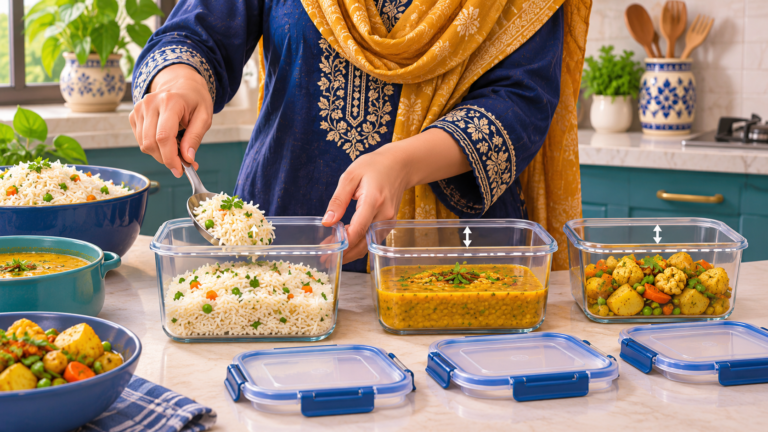
A label may state a container’s total volume, but that number does not promise a clean fill, secure lid, safe transport, or consistent serving. Food shape, expansion, sauce movement, headspace, lid depth, stacking, and cooling all affect the practical fill line. A short physical test turns an assumed capacity into a repeatable packing standard.
Choose the Exact Container and Intended Use
Record the container brand, product code, stated capacity, material, lid type, compartments, and whether the maker allows refrigeration, freezing, reheating, or reuse. A similar-looking lid may not seal the same base.
Define the food, serving temperature, holding time, route, and customer use. A dry snack, hot daal (دال), rice dish, and chilled salad place different demands on a package. FDA guidance says food-contact materials should be suitable for their intended use.
Use one container and lid lot during the first test. If the supplier changes the base, lid, material, or design, repeat the test before treating it as equivalent.
Verify Stated Capacity and Usable Fill
Place the empty container on a level surface and tare a scale. Add water in measured steps to verify the stated volume, then empty and dry it. This confirms basic capacity but does not set the food fill line.
Measure the space taken by the lid inside the base. Some lids dip below the rim, while compartments and rounded corners reduce usable space. Mark several trial levels below that boundary.
The Food Container Fill Count Calculator can estimate counts from a verified working fill. It cannot observe lid contact, food movement, or leakage.
Test the Real Food and Portion Tool
Pack the actual menu item with the normal scoop, ladle, or scale. Thick food can mound above a volume line, loose rice can settle, and sauce can move into lid channels. Test solids and liquid components together.
Weigh at least ten filled containers. Record the target portion, average actual portion, highest and lowest result, and any container that looks crowded. This reveals whether the problem is capacity or portion-control variation.
Do not compress food simply to reach a count. Compression can damage texture, distort the container, and make the published portion difficult to repeat.
Set Headspace and Confirm Lid Closure
Leave enough clear space for the lid to engage without pressing into food. Wipe the sealing rim as the normal procedure requires, then close every side in the maker’s intended sequence.
Inspect the lid at eye level. Look for lifted corners, bowed panels, sauce in the channel, trapped food, or a base that deforms. Open the package again and check whether the lid touched the food.
Approve a working fill line only when trained staff can repeat the closure without unusual force. If the lid needs pressure that bends the base, lower the fill or choose another package.
Run Stack, Tilt, and Transport Trials
Use cool or room-temperature test food when a trial would otherwise create a burn or spill risk. Stack the normal number of packages, leave them for the expected holding period, and inspect the bottom package for bowing.
Place sealed samples in the real bag, crate, or delivery box. Move them along the normal route, including stairs, vehicle turns, or customer handoff where relevant. Keep the test controlled and protect people and surfaces.
After the route, inspect the seal, corners, compartments, exterior, and portion appearance. Record leakage, lid release, food migration, and container damage instead of describing the trial only as passed or failed.
Keep Cooling and Storage Controls Separate
A leak-free container is not proof of safe cooling or storage. FDA Food Code guidance favors methods such as shallow pans, smaller portions, and containers that support heat transfer when cooling food.
Follow local law and the operation’s approved food-safety plan. USDA consumer guidance recommends dividing large amounts into shallow containers and refrigerating leftovers promptly, but commercial requirements may differ.
Link the fill record to any required temperature or cooling log. Do not invent a universal venting, sealing, or shelf-life rule from a capacity test.
Avoid Common Food Container Test Errors
- Using the label volume: verify the real package and lid.
- Testing water only: pack the actual food and components.
- Ignoring the sealing rim: keep food out of the closure path.
- Skipping transport: test the normal stack and route.
- Mixing capacity with safety: keep required controls separate.
Repeat the test after a package, menu, portion tool, route, or holding method changes. Keep a failed sample or photo when it explains the approved lower fill line.
Build a Repeatable Test Record
Use the downloadable CSV for at least three comparable trials. Record the exact container or equipment ID, food or drink, portion tool, fill level, lid or service setup, route, failures, corrections, usable yield, and decision.
Change one factor at a time when possible. If the product, package, portion, temperature, route, and staff method all change together, the team cannot identify the cause of a result.
Keep failed trials and photographs when they explain the approved standard. A failure is useful evidence, not a reason to erase the record.
Name the person who ran the test and the date. Ask another trained person to repeat the accepted setup without verbal help. If that person cannot reproduce it, improve the written standard.
Write a practical range when normal variation makes one exact number misleading. Record the package lot or supplier code when small manufacturing differences could matter.
Review the record after any change to the menu, package, portion tool, appliance, route, service method, or applicable rule. The result belongs to the tested setup.
Download the Test Worksheet
Open the CSV in a spreadsheet and replace the example row with measurements from your own controlled trial.
Keep the Test Traceable
Record the setup, result, failure, correction, and approved operating standard.
Use the Food Container Fill Count Calculator
The Food Container Fill Count Calculator performs the matching arithmetic. This article covers the physical trial and service evidence that a calculator cannot observe.
Calculate With Measured Inputs
Complete a real trial, then enter the verified working volume, portion, count, or service rate.
فوڈ کنٹینر کے عام سوالات
کنٹینر کو کنارے تک بھرنا ٹھیک ہے؟
نہیں۔ ڈھکن، سیل اور کھانے کی حرکت کے لیے مناسب خالی جگہ رکھیں۔
صرف پانی سے حجم چیک ہو سکتا ہے؟
پانی بنیادی حجم بتاتا ہے، لیکن اصل کھانے کی شکل اور گاڑھا پن بھی ٹیسٹ کریں۔
ڈھکن صحیح بند ہونے کی علامت کیا ہے؟
ہر کنارہ مکمل بیٹھے، باکس نہ مڑے اور کھانا سیل کے راستے میں نہ آئے۔
ٹرانسپورٹ ٹیسٹ کیوں ضروری ہے؟
راستے میں جھکاؤ، اسٹیک اور حرکت سے لیک یا ڈھکن کھل سکتا ہے۔
کیا فل ٹیسٹ فوڈ سیفٹی ثابت کرتا ہے؟
نہیں۔ کولنگ، ہولڈنگ اور درجہ حرارت کے منظور شدہ ریکارڈ الگ رکھیں۔
Sources and Further Reading
Related Food Packaging and Service Guides
More Food Packaging Guides

Author and Founder
2 thoughts on “How to Test Food Container Fill Levels Without Overfilling”