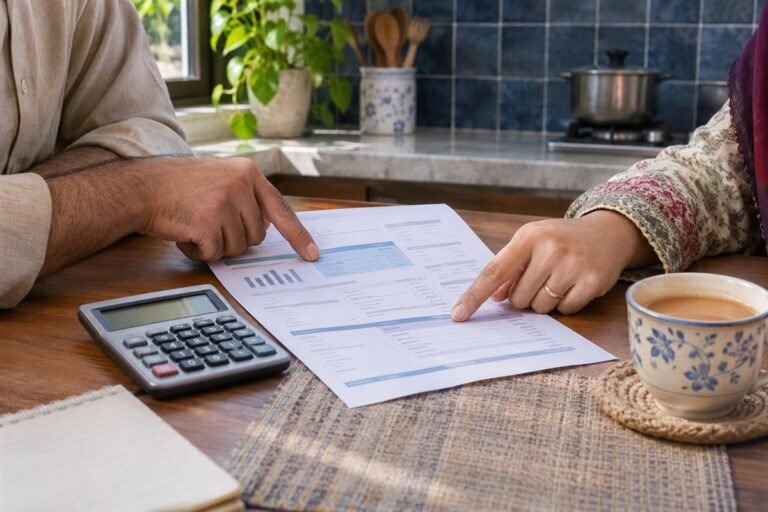
Two people may be home all month while a third moves in halfway through. There is more than one way to split the same utility bill. Write down an agreed method that everyone can check. The figures in this example are fictional PKR amounts.
Check the Bill Before Dividing It
Start with the dates printed on the bill, which may run from the middle of one month to the middle of the next. Match everyone's occupancy to that period. Also check whether the bill includes unpaid charges from an earlier period or a refund. Those entries may involve a different group of people. Keep them visible so the group can agree how to treat them.
Use the actual amount due and note the due date. If the bill lists both a current charge and an old balance, decide which amount belongs in the current split before you calculate. When roommates have agreed in advance who pays which bill, record the agreement with the amount and dates. The worksheet helps with the arithmetic and keeps household payment terms visible.
Choose Between an Equal and an Occupancy-Based Split
An equal split is easy to check when everyone has agreed to share equally. With three people and a PKR 6,000 bill, each person's share is PKR 2,000. This can work even when people use different amounts if the household prefers a simple rule.
When someone moves in or out during the billing period, the group can choose to count resident-days. One resident with an assigned occupancy of 30 days contributes 30 resident-days. A resident with 15 days contributes 15. The count is an agreed way to divide the charge. It is a proxy, because actual use can differ even when two people are present for the same number of days.
Separate Fixed Charges From Usage Charges
Suppose the PKR 6,000 bill contains PKR 900 in fixed charges and PKR 5,100 in charges tied to use. The household agrees to split the fixed charges in three equal shares of PKR 300. It uses resident-days for the remaining PKR 5,100. Two people have 30 days each, and the third has 15, so the total is 75 resident-days.
The usage portion per resident-day is PKR 68. A full-period resident's usage share is PKR 2,040, and the half-period resident's is PKR 1,020. After adding the fixed share, the amounts due are PKR 2,340, PKR 2,340, and PKR 1,320. Together they equal the original PKR 6,000 bill.
Individual usage share = usage charges × that person's resident-days ÷ total resident-days.
If the bill groups all costs into one amount, the household can agree to split the whole amount by one rule. Record which rule applies before entering the figures. If the resident-day total is zero, leave the usage row unresolved until you know who is responsible for that period. Division by zero gives no share.
Decide Which Days Count as Occupancy
Set a clear rule for moves and absences. One household may use the date someone's keys become available. Another may count the days a person is actually at home. If short holidays are included, use the same treatment for everyone. If a person leaves midway through a billing period, use the effective date the group agreed to, then count within the bill dates.
Set a separate rule for anything measured independently. If one room has its own meter and you can identify the charge from its reading, handle that charge separately from shared electricity. Show the reading, dates, and unit price used for the split. Ensure the same charge appears only once when you add up the household total.
When the meter reading is estimated, mark it in the record so the next bill's correction can be traced. Keep the original split alongside any adjustment. If a credit covers a period before someone joined the household, check which earlier charges it corrects before assigning it to a person.
Round the Shares and Record Who Paid
Use full figures until the last step. If PKR 1,000 must be split three ways in whole rupees, three rounded shares of PKR 333 total PKR 999. Assign the final rupee under a rule everyone knows, giving shares of PKR 334, PKR 333, and PKR 333. Check the total after rounding.
The person who pays the provider can record the total cash outflow. Other residents can record their share and the date they repaid it. Do not count the repayment as another utility bill in a combined household budget. Keep it in a payment record so everyone can see what is still outstanding. The CFPB spending tools give examples of tracking expenses and dates in separate documents.
Make the Next Bill Easier to Share
Keep the original statement, the split rule, and the worksheet together. Write a short note if the household used a special rule for one month, such as carrying a prior credit into a different period. Add a due date or agreed repayment date and mark each completed transfer. Share only the information the household needs, and hide account numbers or unrelated personal details.
When the group changes, agree on the new rule before the next bill arrives. A one-line note with the billing dates and number of days per person gives everyone the same starting point. Use the shares from the example to check the worksheet, then replace the example with your own data. MoneyHelper's budget planner also suggests being consistent about whose household expenses are counted.
Download the Worksheet
Replace the fictional example rows with your own figures. Open the CSV in a spreadsheet or print it for a paper record.
اکثر پوچھے جانے والے سوالات
یوٹیلٹی بل برابر تقسیم کریں یا دنوں سے؟
جو اصول سب نے طے کیا ہو وہ لکھیں۔ مدت بدل جائے تو رہائش کے دن الگ گن سکتے ہیں۔
مقررہ چارج کیسے بانٹیں؟
اس حصے کے لیے الگ اصول طے کریں۔ پھر استعمال کا حصہ اسی کے ساتھ جمع کریں۔
نیا رہائشی درمیان میں آئے تو؟
بل کی مدت کے اندر اس کے طے شدہ دن لکھیں۔ باقی افراد کے دن بھی اسی اصول سے گنیں۔
راؤنڈنگ سے ایک روپیہ بچ جائے تو؟
ایک طے شدہ حصے میں شامل کریں تاکہ سب حصوں کا مجموعہ بل کے برابر ہو۔
کسی نے پورا بل دے دیا ہو تو؟
اصل ادائیگی اور دوسروں کی واپس کی گئی رقم الگ درج کریں۔
Sources and Further Reading
Related Budgeting Resources
More Household Budgeting Guides

Author and Founder