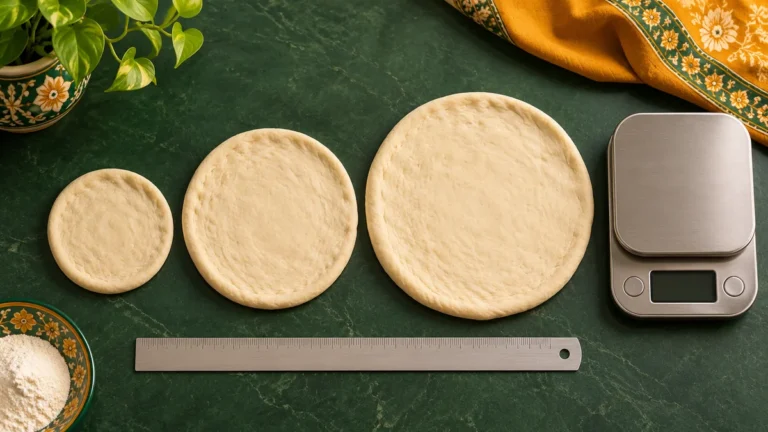
A larger pizza needs more dough because the baking surface is a circle, not a straight line. Diameter describes the distance across the pizza, but dough spreads over the full circular area. That difference explains why adding a few inches can require much more dough than a simple diameter ratio suggests.
Pizza Size and Dough Weight Start With Area
Think about a 12-inch line and a 16-inch line. The second line is one third longer. A pizza, however, has both length and width. When the diameter grows, the surface expands in two directions at the same time.
The area of a circle is pi multiplied by the radius squared. The radius is half the diameter. The square is the key. It means that a diameter change affects the surface more than a straight percentage comparison shows.
This is a geometry lesson, not a fixed dough recipe. Flour strength, hydration, fermentation, rim style, pan depth, and baking method can change the dough weight that gives the result you want.
Compare 12, 14, and 16-Inch Pizza Areas
A 12-inch pizza has an area of about 113 square inches. A 14-inch pizza has about 154 square inches, and a 16-inch pizza has about 201 square inches. These values are rounded for comparison.
Moving from 12 to 14 inches increases diameter by about 17%, but area rises by about 36%. Moving from 12 to 16 inches increases diameter by about 33%, while area rises by about 78%.
This is why a 16-inch dough ball based only on a 33% diameter increase can feel too thin. The same issue affects sauce, cheese, and toppings when they are spread over the full pizza.
Avoid the Straight Diameter Ratio
A common shortcut multiplies the old dough weight by new diameter divided by old diameter. That method treats the pizza like a line. It ignores the second direction of growth and usually underestimates the larger pizza.
Another mistake is adding the same number of grams for every two-inch size step. The added area is not constant. The ring added around a larger pizza covers more surface than the same-width ring added around a smaller one.
Use an area ratio when the goal is to preserve the same thickness. Keep the original dough weight and baked result as your reference instead of borrowing an unexplained number from another kitchen.
Use a Known Pizza as Your Reference
Choose a pizza you already make well. Record its finished diameter, dough-ball weight, pan or screen, fermentation condition, and the result after baking. This becomes a practical baseline for your own equipment.
Measure the baked base only if that is your normal control point. If you shape a 14-inch dough disk that shrinks before baking, a baked diameter and a raw diameter are not interchangeable.
Keep style constant during the comparison. A thin center with a raised rim does not distribute dough like a flat pan pizza. Test one style before applying its result to another.
Run a Controlled Pizza Dough Test
Change only the diameter for the first test. Use the same dough formula, fermentation time, shaping method, oven setup, and target rim. Scale the dough by area, then observe the center, rim, and overall handling.
If the center is too thin, increase the next test slightly. If the base is heavier than you want, reduce it slightly. Record the change in grams and describe the baked result in plain words.
One bake cannot prove a universal standard. Repeat the test under ordinary working conditions. A small record is more useful than a perfect-looking number with no baked evidence.
Record Pizza Size Tests in One Table
The CSV keeps diameter, known dough weight, calculated area, observed loading, and the baked result on one row. It does not choose a thickness for you. It preserves the evidence behind your next choice.
Use centimeters with square centimeters or inches with square inches. Do not place a centimeter diameter beside a square-inch area. Convert first, then calculate.
Compare Pizza Sizes
Save each test before changing the next dough ball.
Connect the Lesson to the Thickness Calculator
The Pizza Dough Thickness Factor Calculator handles the area and dough-weight arithmetic for a round pizza. This article explains why that method is necessary and how to create a trustworthy reference.
Enter measured values from the same pizza style. Read the output as a planning estimate, then confirm it with a bake. The calculator cannot judge crumb, crispness, or handling by itself.
Scale a Tested Dough Weight
Use a known pizza to estimate a new diameter while preserving the same area-based loading.
Know When Area Scaling Is Not Enough
Area scaling works best when the pizza style and process stay similar. It is not a complete recipe-conversion system. A deep pan, stuffed crust, very wide rim, or rectangular tray may need a different reference.
Oven limits also matter. A larger pizza can bake differently because heat reaches the center more slowly. Do not add more dough only because the center seems pale. Review temperature, bake time, screen or pan, and topping load as separate variables.
If a test changes shape as well as size, measure the correct surface geometry. A rectangle uses length multiplied by width. An oval or irregular hand-stretched base may be better checked from a known dough weight and repeated bake than from a false exact area.
Common Pizza Scaling Mistakes
- Scaling by diameter alone: use the circular area ratio.
- Mixing raw and baked diameters: choose one repeatable control point.
- Changing several variables: keep formula and process stable during the first test.
- Rounding each step: keep working precision and round the final planning weight.
- Treating one style as universal: retest when the rim, pan, or baking method changes.
پیزا سائز اور ڈو کے عام سوالات
صرف قطر کے حساب سے ڈو کیوں نہیں بڑھانا چاہیے؟
پیزا ایک دائرہ ہے۔ قطر بڑھنے سے سطح لمبائی اور چوڑائی دونوں طرف بڑھتی ہے، اس لیے رقبے کا تناسب استعمال کریں۔
بنیادی پیزا کون سا رکھیں؟
وہ سائز اور ڈو وزن منتخب کریں جو آپ کے اوون میں پہلے سے اچھا نتیجہ دیتا ہے۔
کیا ہر پیزا انداز کا ایک ہی تناسب ہے؟
نہیں۔ پتلا، پین اور موٹے کنارے والا پیزا الگ ٹیسٹ مانگ سکتا ہے۔
قطر کب ناپیں؟
ہر ٹیسٹ میں ایک ہی مرحلہ منتخب کریں، مثلاً شکل دینے کے بعد یا بیک ہونے کے بعد۔
کیلکولیٹر کے نتیجے کو کیسے چیک کریں؟
ایک ٹیسٹ پیزا بنائیں، بیک شدہ نتیجہ لکھیں، پھر اگلے بیچ میں چھوٹی تبدیلی کریں۔
Sources and Pizza Scaling Resources
View 4 Sources
- Pizza Today. Dough Doctor: Calculating Party-Sized Pizza
- General Mills Foodservice. Basic Pan Pizza Dough Guide
- Open Textbook Store. Math in Society: Geometry and Problem Solving
- NIST. SI Units and Metric Measurement
Related Pizza Planning Tools
Explore More Cooking Calculators
Browse tools for recipe quantities, batch scaling, pizza planning, ingredients, and kitchen measurements.

Author and Founder