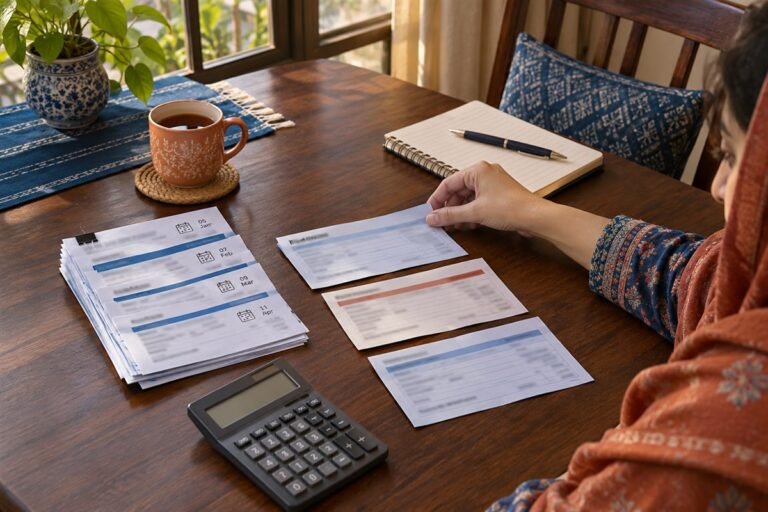
When pay changes from month to month, the highest deposit can make a poor starting point for regular bills. Use your own income history to test a lower planning figure, then see what the budget needs during a slow month. All amounts below are fictional PKR examples.
Separate Money Received From Money Expected
Start with pay slips, bank records, and any cash payments you recorded. Put each receipt in the month it reached you. If PKR 30,000 is due for work completed this month but the client has yet to pay, place it on a separate expected income list. That allows you to plan for it without assuming it can cover an immediate bill.
For self-employment, separate the amount invoiced from what the household can use. In a simplified example, you received PKR 90,000, paid PKR 15,000 in direct work costs, and set aside PKR 6,000 for a known obligation. That leaves PKR 69,000 available for the household. Use your own documented work costs and reserves. The example uses invented amounts, so it provides no estimate of local taxes or fees.
Exclude transfers between your own accounts from income. A transfer can make cash easier to use, but it comes from funds you already counted. When you are unsure about a receipt, keep it unassigned until you can match it to the original payment or deposit.
Compare a Typical Month With a Slow One
Suppose your last six months of usable income were PKR 58,000, 73,000, 91,000, 62,000, 104,000, and 68,000. The six payments add up to PKR 456,000, an average of PKR 76,000 per month. Sort the values and the middle two are PKR 68,000 and 73,000, giving a median of PKR 70,500. Both summarize the history. Neither tells you the amount you will receive next month.
Choose a lower planning figure using the record and what you know about the months ahead. In the example, PKR 62,000 is a test figure because it is near the bottom of the observed range. Test PKR 58,000 separately to see what would happen in the lowest recorded month. MoneyHelper discusses using a lower income level to plan irregular bills.
Check the Minimum Household Costs Against the Plan
List the costs you expect even in a slow month. Use actual bills and recent receipts so you can identify each amount. Keep planned savings and flexible costs on separate lines. If a cost is paid every few months, include the amount you intend to reserve this month and track its actual due date separately.
In the example, essential costs total PKR 61,000. At PKR 62,000 income, that leaves PKR 1,000. At PKR 58,000, those same costs leave a PKR 3,000 shortfall. The budget now shows what has to change in a slower month even if annual income still looks sufficient.
Balance before flexible spending = usable income received − essential costs and reserves included in the plan.
The sheet can also show you when an essential bill is higher than usual. A one-month price increase affects that month's result. A continuing increase can change the amount you need to budget in every month. Keep those notes with the amount rather than trying to explain the whole difference through income.
Plan for Two Slow Months in a Row
If slow months cluster, test them together. Two months with income of PKR 58,000 and PKR 56,000 against PKR 61,000 of costs each leave gaps of PKR 3,000 and PKR 5,000. If the forecast starts with no available carryover, the combined planned gap is PKR 8,000. Real payment dates can still bring some of that need forward.
An income buffer is money you set aside before a slower period. Track the amount available for this purpose on its own line. Keep it separate from money already reserved for a school bill or another goal. You can then see which shortfalls the same starting balance can cover without assigning it twice.
Decide What a Strong Month Can Cover
At PKR 91,000 of usable income, the same PKR 61,000 core costs leave PKR 30,000 before any additional allocations. If you choose to set aside PKR 8,000 for the two-month scenario, PKR 22,000 remains before other planned costs. This example shows one way to test an allocation. Use your own dated bills and obligations to decide what the extra income can cover.
Avoid building next month's regular spending plan around one larger payment. Mark whether that payment came from a typical contract, seasonal work, or a one-time job. If your income rises for several months because a new agreement has begun, check the agreement and available payment evidence before revising the planning figure.
Keep a Short Record That You Can Update
Use the worksheet for a history of what came in, a cautious plan for the next month, and a slow-month test. Enter an update when a due payment arrives or moves to a new date. At month-end, compare your recorded income with the amount originally expected. Note the reason for any difference you understand, such as a delayed delivery or fewer shifts.
Some households have more than one source of variable income. Check each source separately and consider whether the low months tend to happen together. The CFPB cash flow budget worksheet can help you place expected payments and bills by week after you choose a planning figure.
Download the Worksheet
Replace the fictional example rows with your own figures. Open the CSV in a spreadsheet or print it for a paper record.
اکثر پوچھے جانے والے سوالات
اگر آمدنی بدلتی رہے تو بجٹ کیسے بنائیں؟
چند مہینوں کی وصول شدہ رقم لکھیں۔ کم آمدنی والے مہینے کو سامنے رکھ کر ضروری خرچ کا حساب آزمائیں۔
جو رقم ابھی نہیں ملی اسے شامل کریں؟
متوقع رقم الگ لکھیں۔ وصول ہونے سے پہلے اسے موجود نقدی میں شامل نہ کریں۔
اوسط آمدنی کیوں دیکھیں؟
اس سے پچھلے مہینوں کا اندازہ ملتا ہے۔ اگلے ماہ کی اصل رقم اور تاریخ حساب میں الگ رکھیں۔
دو کم آمدنی والے مہینے ہوں تو؟
ہر مہینے کا فرق نکالیں۔ پھر دیکھیں کہ دونوں کے لیے کتنی مجموعی رقم درکار ہے۔
اچھی آمدنی والے مہینے میں کیا لکھیں؟
پہلے ضروری رقم الگ دکھائیں۔ باقی رقم میں سے آنے والے کم آمدنی کے عرصے کے لیے ممکنہ بچت درج کریں۔
Sources and Further Reading
Related Budgeting Resources
More Household Budgeting Guides

Author and Founder