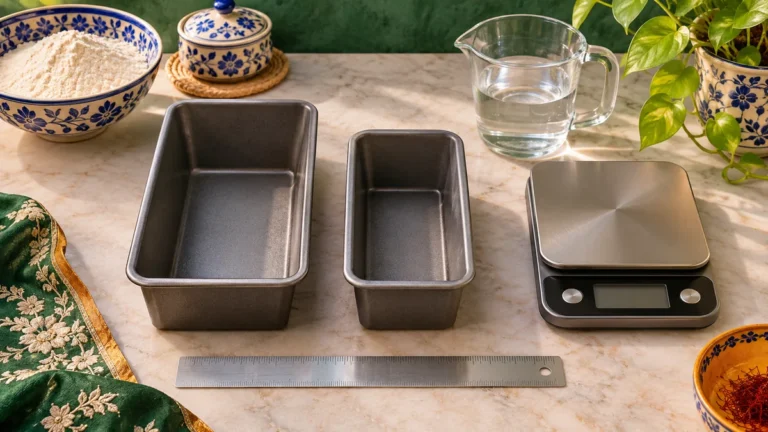
Bread pan labels are not always enough for dough scaling. Two pans sold under the same common size can have different inside walls, slopes, corners, or usable depth. A useful pan record starts with the space inside the pan, then connects that measurement to a dough weight you have tested.
Start With the Bread Pan’s Inside Space
Place the clean, empty pan on a stable surface. Measure between the inner walls. Do not include the thickness of the metal, handles, rolled rim, or lid rails in the usable dimensions.
Use centimeters for a compact record and keep all measurements in the same unit. Measure to a precision your ruler can support. A ruler marked in millimeters does not justify a value smaller than the marks you can read.
Give the pan a simple household label such as “small silver loaf pan.” A photo can help, but the written label should still distinguish it from other pans.
Measure Top and Bottom Dimensions on Sloped Pans
Many loaf pans are wider at the top than at the bottom. Measure inside top length and width, then repeat near the bottom. A single top measurement can overstate the space available near the base.
Keep the ruler level and measure the flat inside span. Rounded corners make an exact geometric volume difficult, so treat the dimensional result as an estimate.
For a straight-sided Pullman pan, top and bottom measurements may be nearly the same. Still record the lid style and rails because they can affect the usable rise space.
Choose a Repeatable Usable Depth
Measure from the inside base to the level you intend to treat as the pan’s usable top. For an open pan, that may be the inner rim. For a lidded pan, it may be the underside of the closed lid.
Do not change the depth to make a preferred dough weight fit the record. The measurement should describe the pan. Your bake test decides how much dough works for the bread style.
Record dents, unusually rounded bases, or inserts that reduce space. A paper liner normally changes capacity very little, but a thick reusable insert may matter.
Use Water Capacity as a Practical Cross-Check
A water check can capture sloped walls and rounded corners better than a simple rectangular estimate. Place the pan on a level surface and add a measured amount of water to the chosen usable level.
For a scale method, weigh the empty dry pan, add water, and weigh again. The mass difference in grams is close to the water volume in milliliters under ordinary kitchen conditions. Keep this as a practical check, not laboratory calibration.
Dry the pan promptly and follow its care instructions. Do not use this method on a pan that should not be exposed to standing water.
Connect Pan Capacity to a Tested Dough Weight
Capacity alone does not decide the right dough weight. A dense sandwich loaf, soft enriched dough, and highly aerated dough can fill the same pan differently.
Choose one bread formula and record the raw dough weight placed in the pan. After baking and cooling, note whether the loaf was too low, properly domed, pressed into a lid, or overflowed.
Keep proofing and baking conditions reasonably similar during the comparison. A pan record becomes useful when it connects measurements to an observed loaf.
Download the Bread Pan Measurement Record
The CSV stores inside top and bottom dimensions, usable depth, water capacity, reference dough weight, and baked result. Replace the sample row with your own pan.
Use a new row after a major process or formula change. Do not erase an older successful reference when a different dough behaves differently.
Build a Bread Pan Record
Keep the pan measurement and one tested dough weight together.
Use the Bread Pan Dough Weight Calculator
The Bread Pan Dough Weight Calculator applies your pan dimensions and tested loading factor. This article owns the measurement process that supplies dependable inputs.
Enter inside measurements from the same method. Treat the result as a starting weight, then confirm it with your dough and oven. The calculator cannot judge proof height or crumb from dimensions alone.
Estimate Dough for a Measured Pan
Take your checked inside dimensions and tested loading factor to the calculator.
Know When Pan Volume Is the Wrong Measure
Pan volume fits enclosed loaf shapes better than flat breads. Focaccia and pan pizza depend more on covered surface area and target thickness. Use a tool designed for those shapes.
Decorative molds, tubes, and very irregular pans may be better recorded by water capacity and a bake test. A simple length by width by depth estimate can misrepresent them.
Do not copy a dough weight from a pan with similar outside dimensions. Compare the inside space, bread style, and observed result before transferring the reference.
Common Bread Pan Measurement Mistakes
- Using outside dimensions: measure between the inner walls.
- Ignoring sloped sides: record top and bottom spans.
- Mixing inches and centimeters: use one unit system per calculation.
- Treating capacity as a recipe: connect it to a tested dough weight.
- Changing the reference silently: add a dated row for a new dough or process.
بریڈ پین کی پیمائش کے عام سوالات
پین باہر سے ناپیں یا اندر سے؟
ڈو کے لیے قابل استعمال جگہ اندر ہے، اس لیے اندرونی دیواروں کے درمیان پیمائش کریں۔
ترچھی دیوار والے پین کو کیسے ناپیں؟
اوپر اور نیچے کی لمبائی اور چوڑائی الگ لکھیں، پھر پانی کی گنجائش سے بھی جانچ کریں۔
پانی سے گنجائش ناپنا ضروری ہے؟
ضروری نہیں، مگر گول کونوں اور ترچھی دیواروں والے پین میں یہ اچھا عملی چیک ہے۔
کیا گنجائش سے ڈو وزن پکا معلوم ہوتا ہے؟
نہیں۔ بریڈ کی قسم اور ابھار مختلف ہوتے ہیں، اس لیے ایک ٹیسٹ بیک ضروری ہے۔
کیلکولیٹر میں کون سی اکائی رکھیں؟
تمام لمبائیاں ایک ہی اکائی میں رکھیں اور نتیجے کو اپنے ٹیسٹ پین سے چیک کریں۔
Sources and Bread Pan Measurement Resources
View 4 Sources
- NIST. Metric Kitchen: Cookware and Tools
- NIST. SI Units and Metric Measurement
- King Arthur Baking. A Complete Guide to Baking Pans
- General Mills Foodservice. Basic Pan Dough Guide
Related Bread Planning Tools
Explore More Cooking Calculators
Browse tools for recipes, dough formulas, bread production, pizza planning, and kitchen measurements.

Author and Founder