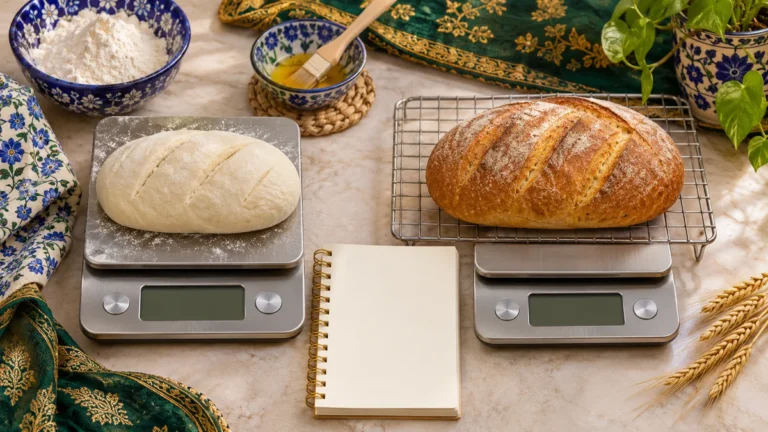
Bread loses mass during fermentation, baking, and cooling, mainly as moisture and gases leave the dough. A useful baking-loss record compares the same loaf at clearly defined stages. If timing and loaf identity change between tests, the percentages may look precise while describing different conditions.
Define the Bread Baking Weight Loss Test
Choose the two stages your main calculation will compare. A common household test uses raw scaled dough weight and cooled loaf weight. Write the cooling period so later tests use the same basis.
You may also record weight at oven removal. That extra reading shows how much mass changes during cooling, but it should not replace the cooled endpoint without a clear reason.
Use the same scale when possible. Place it on a firm, level surface and check that the loaf fits without touching another object.
Label and Match Every Bread Loaf
When baking several loaves, assign a simple number or pan position to each one. Keep the raw and baked readings linked to the same loaf.
Do not compare the total raw batch with one finished loaf. Either follow individual loaves or compare complete batch totals that include the same units.
Record toppings, wash, seeds, or added flour when they materially change the measured weight. Apply them at a consistent stage in repeated tests.
Weigh Raw Dough at a Clear Stage
Weigh the scaled piece before it enters the pan or immediately after panning, depending on your chosen method. Use the same point in future tests.
Tare the pan if the dough is weighed inside it. If you weigh dough alone, keep flour or oil on the platform from affecting the next reading.
Record the raw weight before proofing if that is your standard. Fermentation can release gases and leave dough on covers or tools, so a post-proof reading is a different stage.
Record the Bake and Oven-Removal Weight
Write the oven setting, bake time, loaf shape, pan or freeform method, and any major steam step. These details help explain differences without pretending the oven dial is a calibrated laboratory reading.
At oven removal, handle the hot pan and loaf safely. If you record this weight, use a heat-safe method and do not damage the scale.
Record whether the loaf remains in the pan for part of cooling. Pan time can affect when and how moisture leaves the loaf.
Use a Fixed Cooling Endpoint
A loaf continues to lose moisture as it cools. Choose a practical endpoint such as a fixed number of minutes after oven removal, then keep it consistent.
Cool loaves in similar conditions when comparing batches. A rack, covered surface, room airflow, and loaf spacing can change the cooling environment.
Do not delay safe handling simply to reach an exact minute. Note a timing difference and treat the comparison with appropriate caution.
Download the Bread Baking Loss Record
The CSV stores raw, oven-removal, and cooled weights with cooling time, shape, pan method, and oven notes. Replace the sample row with your own loaf.
Use one row per loaf or a clearly labelled batch total. Several ordinary tests reveal more than one unusually dry or underbaked loaf.
Track a Bread Weight Test
Keep every reading tied to the same loaf and stage.
Use the Bread Baking Loss Calculator
The Bread Baking Loss Calculator compares the raw and baked weights you enter and reports the arithmetic change. This article owns the controlled measurement process.
Enter weights from the same loaf or matched batch. Read the percentage with its stage and cooling conditions. The calculator cannot decide whether a loaf is properly baked.
Calculate Loss From Matched Weights
Take the raw and defined final weight from your record to the calculator.
Compare Bread Weight Loss Carefully
Compare like with like. Loaf mass, shape, crust area, pan use, formula, oven process, and cooling time can all affect the observed change.
A long thin loaf has more exposed surface relative to its interior than a compact loaf. Do not use its result as a universal target for pan bread.
Look for a repeatable range from your own ordinary batches. Investigate a sudden change before adjusting every dough weight or bake time.
Common Bread Baking Loss Test Errors
- Mixing different loaves: match every reading to one label.
- Changing the cooling time: use a defined endpoint.
- Including the pan in one reading: tare containers consistently.
- Comparing unlike shapes: keep loaf style and process visible.
- Treating loss as doneness: use appropriate baking checks separately.
بریڈ بیکنگ وزن میں کمی کے عام سوالات
کون سا وزن پہلے لکھیں؟
ایک واضح خام ڈو مرحلہ منتخب کریں، مثلاً پین میں رکھنے سے پہلے، اور ہر ٹیسٹ میں وہی رکھیں۔
اوون سے نکلتے ہی وزن ضروری ہے؟
اختیاری ہے۔ یہ کولنگ کے دوران تبدیلی دکھا سکتا ہے، مگر محفوظ طریقہ استعمال کریں۔
ٹھنڈا وزن کب لیں؟
ایک مقررہ کولنگ وقت منتخب کریں اور ہر موازنہ میں وہی وقت استعمال کریں۔
کئی روٹیاں ہوں تو کیا کریں؟
ہر روٹی کو نمبر دیں یا مکمل بیچ کے ایک جیسے مرحلے کے مجموعی وزن استعمال کریں۔
کیا وزن میں کمی سے ڈوننس معلوم ہوتی ہے؟
نہیں۔ یہ صرف وزن کی تبدیلی ہے، مکمل بیک ہونے کی الگ مناسب جانچ کریں۔
Sources and Bread Baking Loss Resources
View 4 Sources
- U.S. Government Publishing Office. Bread Formulas and Production Guidance
- Foods. Measurement of Bread Weight and Baking Loss
- FoodBalt. Bread Weight Loss and Loaf Quality Study
- NIST. Metric Kitchen: Cookware and Tools
Related Bread Planning Tools
Explore More Cooking Calculators
Browse tools for recipes, dough formulas, bread production, pizza planning, and kitchen measurements.

Author and Founder