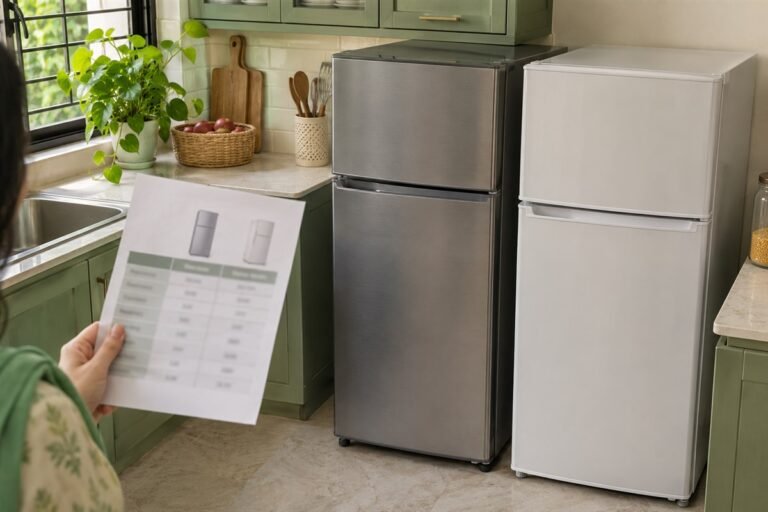
One appliance can cost less at the shop and more on the electricity bill. Comparing both costs over the same twelve months gives you a clearer estimate. This guide uses fictional prices and energy use in PKR, with no current tariff or product recommendation.
Compare Appliances That Can Do the Same Job
Select two models with capacity and features that meet your needs. If one is much larger or replaces another appliance, make a note of what changes before you compare the amounts. A higher total may buy a different service, and the reasons should be clear beside the prices. Record the exact model numbers so you can match the correct labels, prices, and installation instructions.
Use the twelve months after purchase for both models. Write the planned start date if your first year starts midyear or during an unusually hot or cold season. If your comparison uses a full year of label data, state that fact. The FTC's EnergyGuide explanation shows how to use comparable annual energy figures on US labels. Use the figures for the models you are considering and the conditions noted on their own labels.
Include the Costs Due Before First Use
For the fictional comparison, Appliance A costs PKR 52,000 and has PKR 2,000 in delivery and installation charges. Appliance B costs PKR 58,000 and has PKR 1,000 in setup charges. A costs PKR 54,000 to get ready, compared with PKR 59,000 for B. B needs PKR 5,000 more upfront.
Check what each quote covers. An old appliance removal fee, replacement plug, hose, or fitting may only appear on one offer. If a charge is already included in the shop price, leave it out of the extra-cost line. If you plan to buy in installments, use the total payments and known fees for the time span you are comparing. Keep amounts due later visible on their own dates in a separate cash plan.
Calculate Electricity Cost Using Comparable Energy Use
Read the estimated annual electricity use in kilowatt-hours, shown as kWh. One model in the example uses 240 kWh per year and the other uses 150 kWh. At a fictional PKR 50 per kWh, those are PKR 12,000 and PKR 7,500 in estimated electricity costs. Use the same rate assumption when you want to isolate a difference in energy use.
First-year cost = purchase price + delivery and setup + annual kWh × cost per kWh + other known first-year costs.
If you measure energy use yourself, record how long the measurement ran and what happened during that period. Short measurements can miss changes in weather or operating cycles. The U.S. Department of Energy's Energy Saver guide discusses appliance energy use. Avoid treating a rated maximum power as the same as annual energy use. A device that cycles on and off draws different power over a day.
Convert a Per-Cycle Figure Before Comparing
If your label gives energy per 100 cycles and you expect 150 cycles in your first year, multiply by 150 and divide by 100. For example, 65 kWh per 100 cycles becomes 97.5 kWh for 150 cycles. Apply the same use count and comparable settings to the second model. Keep that use count with your worksheet so you can change it later without guessing what the annual number meant.
Check the First-Year Total at Two Electricity Rates
At PKR 50 per kWh, A totals PKR 66,000 and B totals PKR 66,500. A is lower by PKR 500 for the first year under those assumptions. When the rate assumption is PKR 60 per kWh, A's electricity cost increases to PKR 14,400 and B's to PKR 9,000. The revised totals are PKR 68,400 for A and PKR 68,000 for B, so B is lower by PKR 400 on that scenario.
Both rate values are examples. Review the part of your bill that changes with energy use if you want to compare the extra electricity costs. A fixed charge paid with either appliance can stay out of the side-by-side comparison. If your bill changes per unit by usage band or time, use a range or calculate the relevant periods separately. Save the rate and billing period next to the results.
Keep Upfront Cash and Running Cost Visible
Even a lower estimate across twelve months can need more cash on purchase day. In this case, B's upfront cost remains PKR 5,000 higher in both rate scenarios. Keep that amount separate when deciding how much to set aside before buying. If the appliance will be used for several years, build a new comparison with the longer time span and your own expectations for repairs, energy use, and any change in rates.
Check other costs only when you have a usable estimate. Some appliances use water or require regular filters and other supplies. Add a separate line for each likely first-year cost. If a price is unknown, mark it as unknown and test how much it would change the difference. This is especially useful when the first comparison is close.
Save the Assumptions With the Worksheet
For each model, keep the quote date, model number, energy figure, rate assumption, and included extras. Recheck the calculation when a quote expires or you find a charge that was missing. Use the results to compare the options under the same conditions. A different household or a different way of using the appliance can change the result. Explore Household Energy & Fuel Cost Planning for related energy planning topics.
Download the Worksheet
Replace the fictional example rows with your own figures. Open the CSV in a spreadsheet or print it for a paper record.
اکثر پوچھے جانے والے سوالات
پہلے سال کی لاگت میں کیا شامل کریں؟
خریداری، ترسیل، لگانے کا خرچ اور بارہ ماہ کی متوقع بجلی کا خرچ الگ لکھیں۔
بجلی کا خرچ کیسے نکالیں؟
سالانہ کلو واٹ گھنٹے کو اپنے استعمال پر لاگو فی یونٹ رقم سے ضرب دیں۔
دونوں ماڈل کیسے چنیں؟
وہ ماڈل دیکھیں جن کی گنجائش اور کام آپ کی ضرورت کے مطابق ہوں۔
اگر بجلی کی قیمت بدل جائے تو؟
دونوں ماڈل نئی فرضی شرح سے دوبارہ نکالیں اور فرق دیکھیں۔
دکان کے نرخ میں ترسیل ہو تو؟
اگر نرخ میں ترسیل شامل ہے تو اسے الگ خرچ میں دوبارہ نہ لکھیں۔
Sources and Further Reading
Related Budgeting Resources
More Household Budgeting Guides

Author and Founder